Georges de La Tour
He painted darkness with a single candle, and made it the most still and sacred light in European art.
Style and technique
De La Tour's paintings are among the most immediately recognisable in European art: a small number of figures in near-complete darkness, lit by a single candle whose flame is frequently hidden or partially obscured, the light carving out faces and hands from the surrounding blackness with a precision that no other painter of the period achieved.
He worked in two distinct modes. The daytime paintings — genre scenes of gamblers, musicians, fortune-tellers, blind men — are Caravaggesque in spirit: dark backgrounds, strong tonal contrasts, working-class subjects treated without condescension. The night paintings — the candlelit religious subjects — are something else entirely: still, concentrated, mysterious, the darkness not threatening but encompassing, the single light source making each face a focus of absolute attention.
In the night paintings, form is radically simplified. De La Tour had a tendency toward geometric simplification that went much further than most Caravaggesque painters — his figures are almost sculptural in their solidity, their clothing described in broad, flat planes of colour rather than in detailed drapery folds. The result is a quality of monumental stillness that makes even domestic subjects feel ceremonial.
Four fingerprints: candlelit darkness as the primary compositional environment, simplified, almost geometric figures with a monumental solidity, hidden or obscured flame — the candle whose source is behind a hand or a cloth — as a recurring formal device, and a limited range of subjects — the Magdalene, the Nativity, St Joseph, card players and musicians — treated with obsessive repetition and formal refinement.
Life and legacy
De La Tour was born on 13 March 1593 in Vic-sur-Seille, a small town in the duchy of Lorraine, then a semi-independent territory between France and the Holy Roman Empire. His father was a baker; his mother came from a family with some administrative standing. He married in 1617 into a reasonably prosperous local family, which gave him access to social circles considerably above those of his birth.
Little is known of his training. He was probably apprenticed in the Lorraine region, but there is no documentation of a journey to Italy — the usual education for ambitious painters of the period — and no clear evidence that he ever left Lorraine for an extended time. The Caravaggesque style that dominates his work was widely disseminated across northern Europe by the 1610s and 1620s through prints and through the movement of Dutch and Flemish painters, so direct knowledge of Rome was not necessary.
He built his career in Lunéville, where he eventually settled and became a citizen. He was appointed official painter to the King of France at some point — probably in the 1630s — and was well enough regarded to receive gifts from the Duke of Lorraine. He was a prosperous and respected figure in his community, which is irreconcilable with the romantic mythology of the solitary genius in darkness.
The 1630s were the most productive decade of his career. The night paintings — the Magdalene, the Nativity, the carpenter's shop with St Joseph and the young Jesus — were made in this period. They were clearly well known in his lifetime, as copies were made and some works were given as diplomatic gifts.
The Thirty Years War, which ravaged Lorraine repeatedly from the 1630s onward, was a catastrophe for the region and may have affected his output. The town of Lunéville was occupied, sacked, burned, and plagued in succession. Whether he continued to paint through these years, and what happened to the works, is not fully known.
After his death, his name disappeared from the works he had made. The re-attribution of his oeuvre in the early twentieth century was one of the most dramatic recoveries in art history.
Five famous paintings
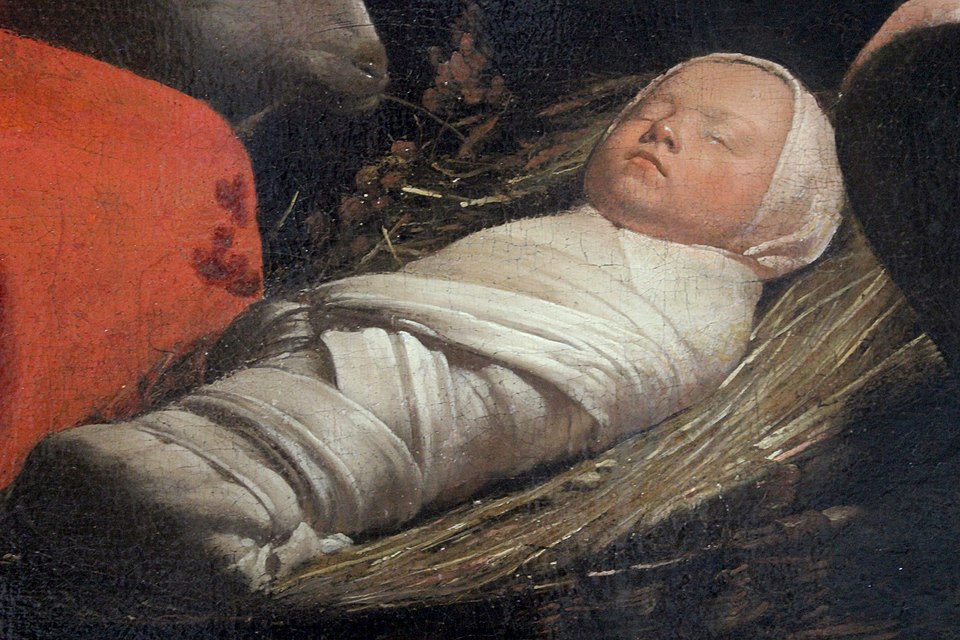
The Newborn 1645
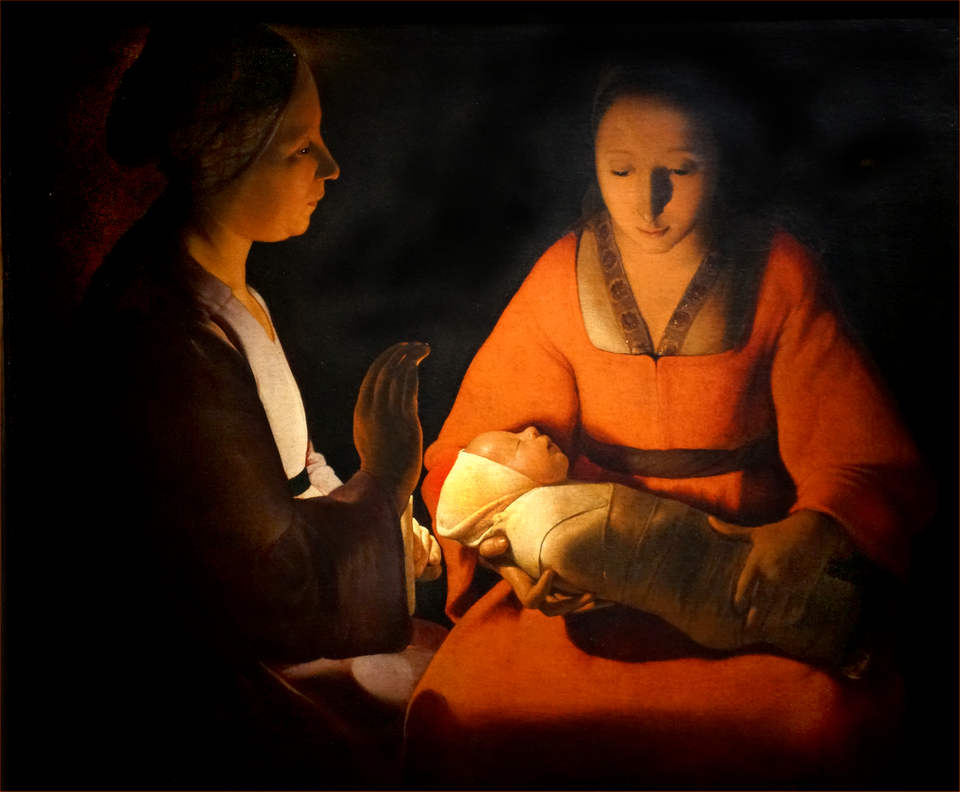
The most tender of his night paintings: a woman holds a newborn infant in swaddling cloth, leaning slightly over it, her face illuminated by a candle held by another woman behind her. The child is lit from the candle's glow; the face of the watching woman is in semi-darkness. The subject may be the birth of Christ or simply a birth — the painting refuses easy identification. What it is certainly about is the quality of attention — the absorbed gaze of two women looking at a new life in a dark room. The candlelight on the infant's face is among the most precisely observed light effects in seventeenth-century painting. It is in the Musée des Beaux-Arts in Rennes.
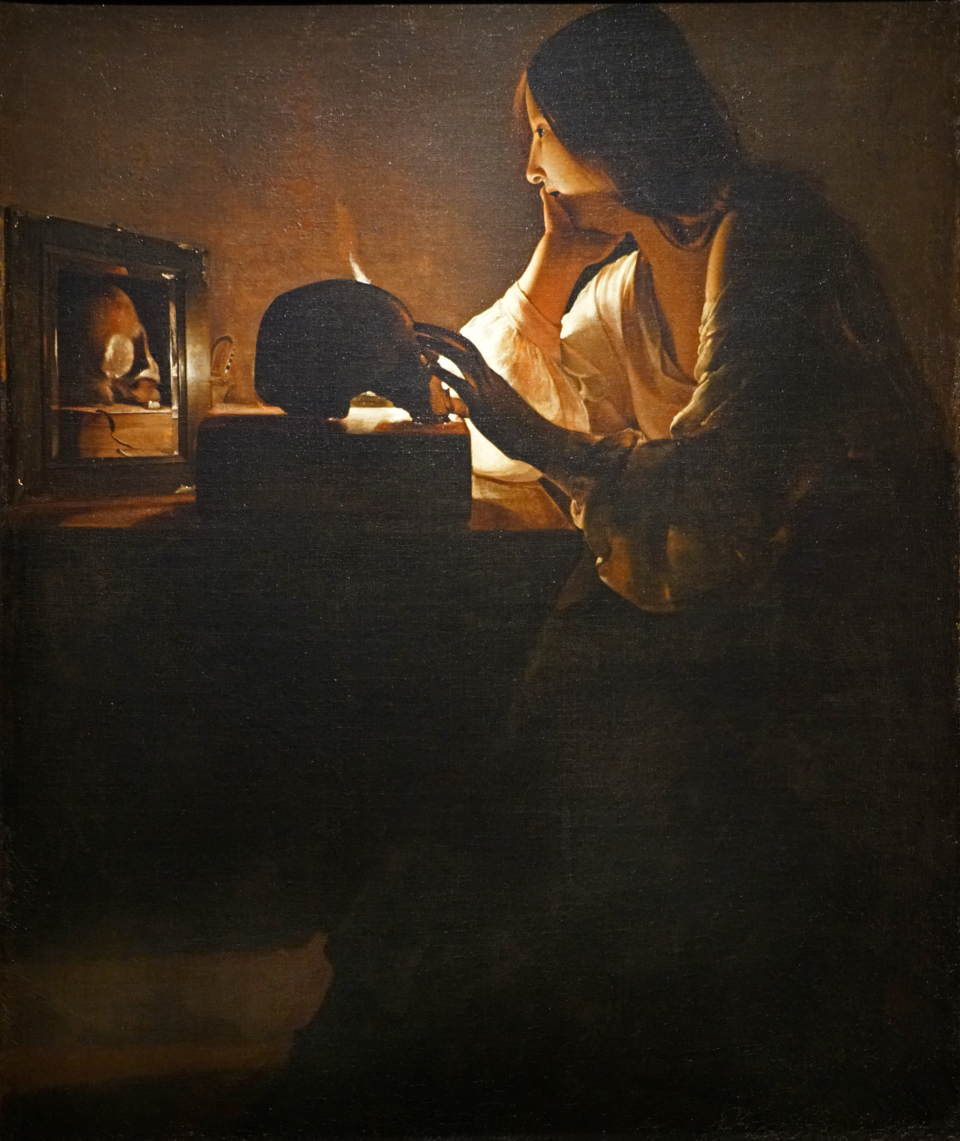
The Penitent Magdalene 1640
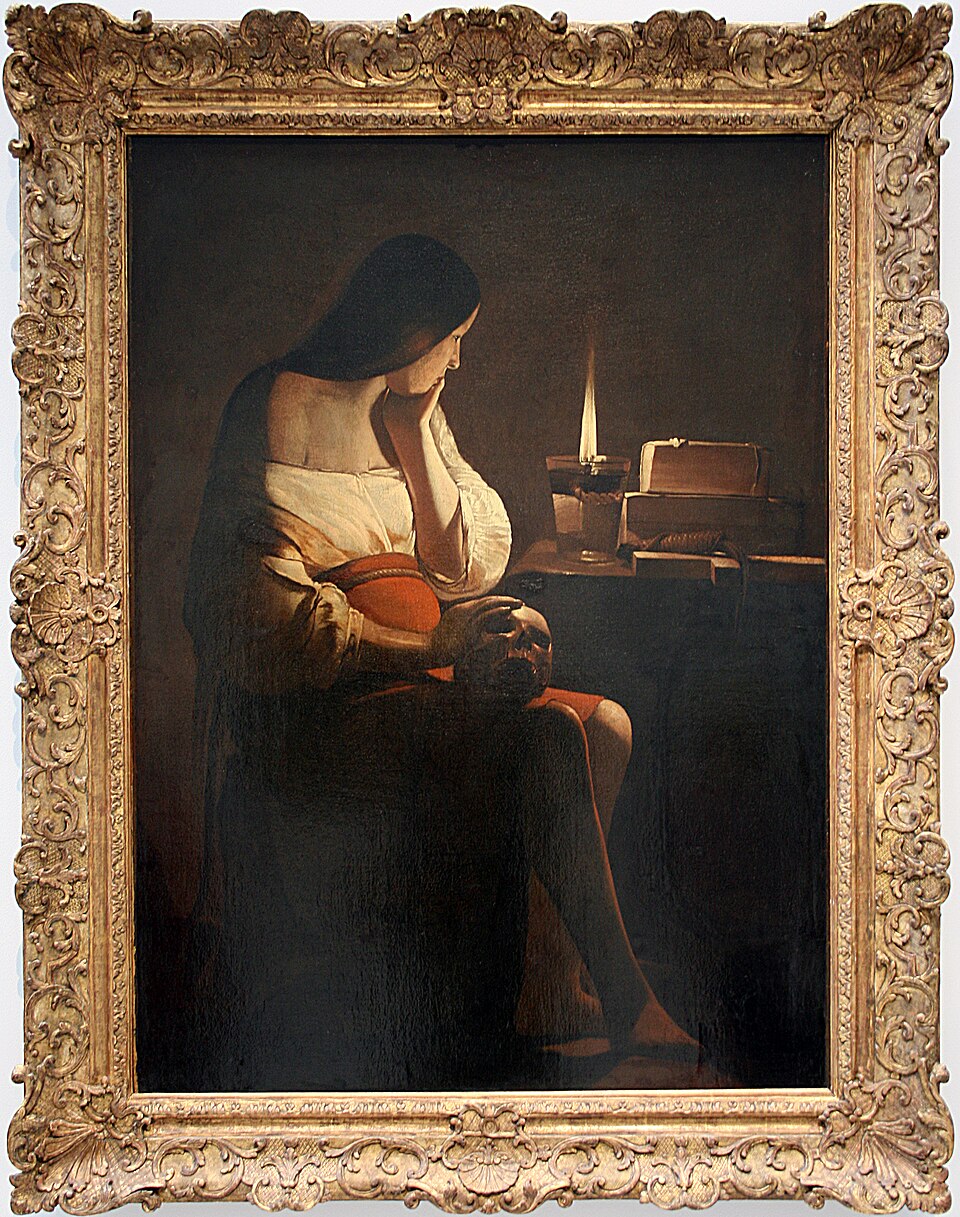
The Magdalene sits before a table, resting her chin on her right hand, contemplating a skull on which her left hand also rests. A single candle burns on the table; the flame is partly visible, casting the figure in warm light against an almost total darkness. The mirror behind the skull adds depth — and another face — to the composition. This is the most famous of his several Magdalene paintings, and the one in which the combination of physical stillness and formal simplicity is most complete. The figure's face has the absorbed, unreachable quality that characterises all his best work. It is in the Metropolitan Museum of Art in New York.
The Cheat with the Ace of Diamonds 1635
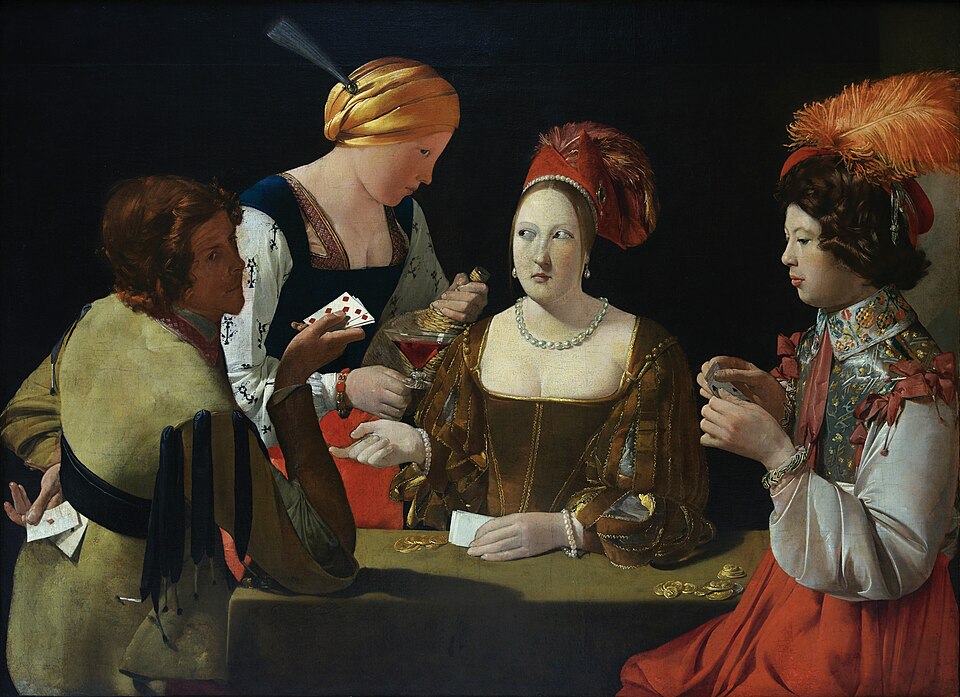
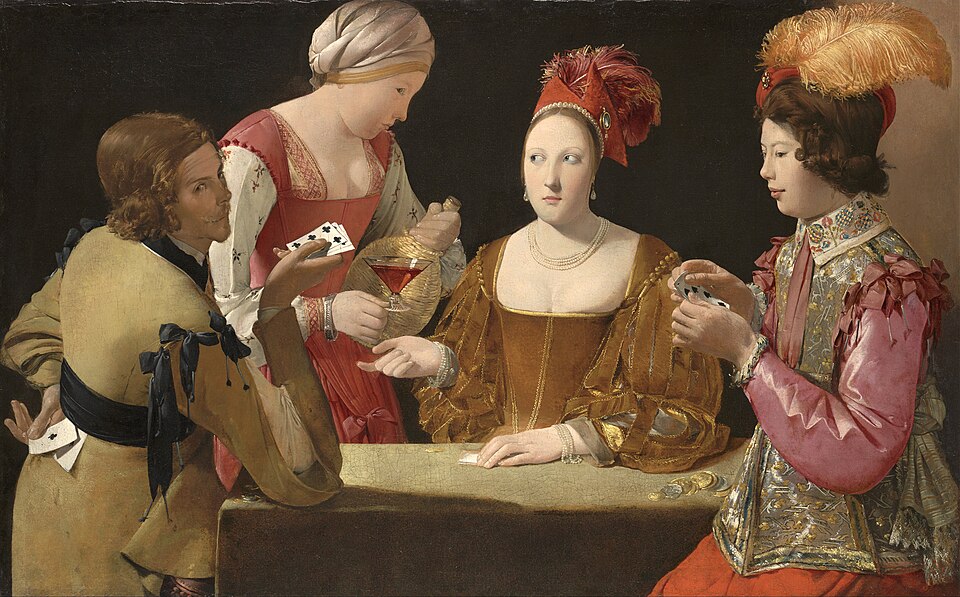
A daytime genre painting showing a young man at a card table caught in the act of producing a hidden card; behind him, a young woman looks toward the viewer with an expression of sly complicity, while a third figure at the table is apparently oblivious. The painting is extraordinary for its surface detail — the costumes, the cards, the wine glasses — and for its implicit narrative: everyone in the picture except the victim knows what is happening. It is one of the most psychologically complex pictures de La Tour made, and it shows that his range extended well beyond the contemplative night paintings. It is in the Louvre.
The Adoration of the Shepherds 1644
A group of figures gathered around the newborn Christ, lit by a single candle held by one of the shepherds and partially obscured by his hand. The faces come out of the darkness as pools of warm light; the expressions are absorbed and quiet — not the ecstatic rapture of Baroque religious painting but something more like wonder and exhaustion simultaneously. The simplification of the figures is at its most complete here; the bodies are almost columnar, the clothing reduced to broad geometric planes. The painting was given to Louis XIII by the Duke of Lorraine. It is in the Louvre.
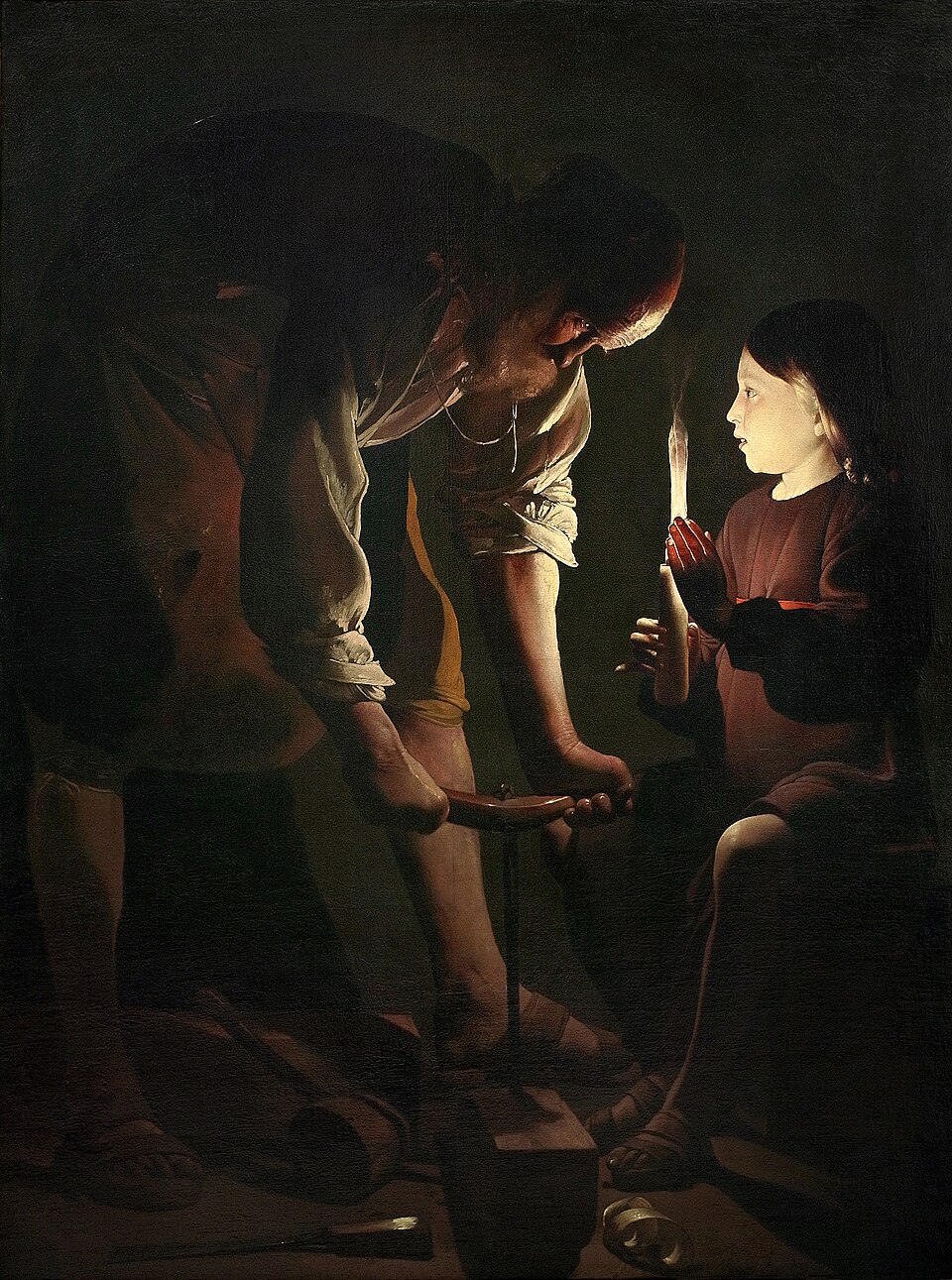
Saint Joseph the Carpenter 1642
The young Jesus holds a candle whose flame illuminates both his face and, from below, the face of Joseph who is working with an auger or drill. The hidden flame — behind the child's fingers — is one of de La Tour's most ingenious formal devices: the light seems to come from within the child rather than from a candle he is merely holding. The warm, steady glow on Joseph's bearded face and the child's serene expression give the night workshop the quality of a vision. It is in the Louvre.