Rembrandt
The painter who made every shadow feel inhabited.
Style and technique
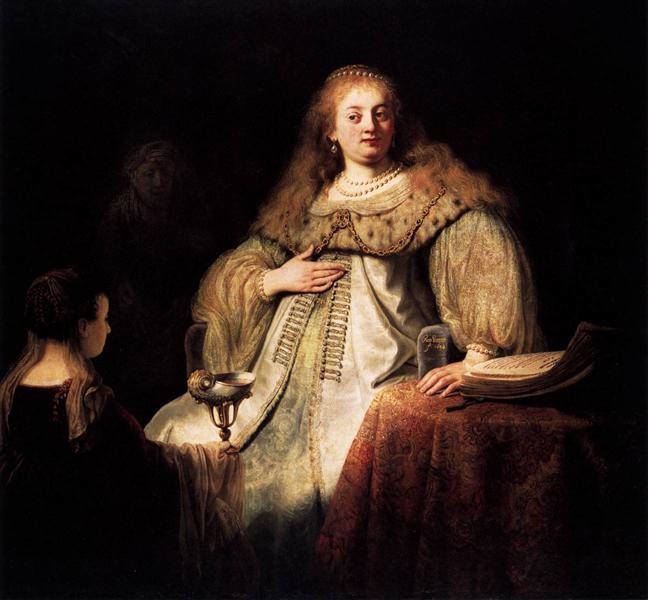
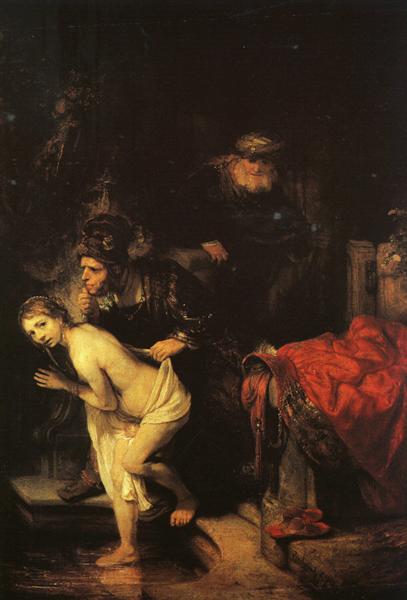
Rembrandt's whole achievement can be compressed into a single technical observation: he painted darkness. Not blackness as a neutral background, but warm, breathing, inhabited darkness — the kind you find in a room with one candle and old wooden furniture that has absorbed decades of smoke. Against that darkness his figures emerge, their faces and hands catching the light as if they have just stepped forward out of the night.
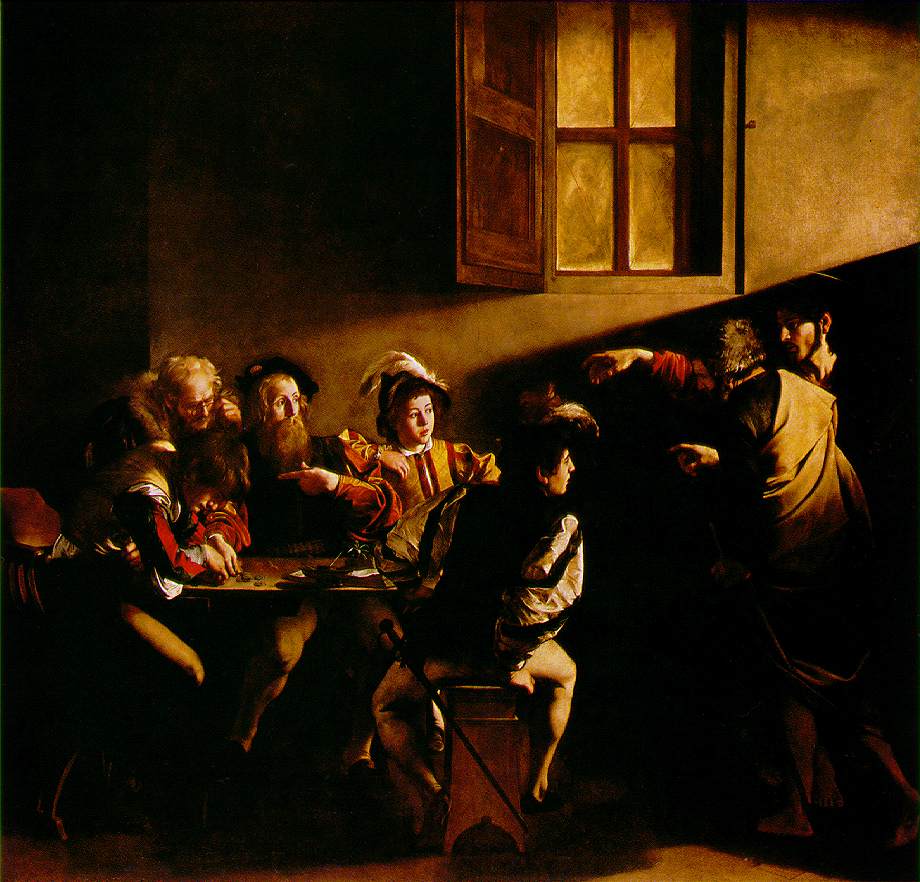
This is chiaroscuro pushed to its psychological extreme. He learned the basic grammar from Caravaggio's innovations, but where Caravaggio used one harsh beam of theatrical light, Rembrandt diffused his illumination until it seemed to come from within the figures themselves. A face in a late Rembrandt portrait does not look lit; it looks luminous.
His working method changed fundamentally after 1650. In his early career he was smooth, polished, technically dazzling in a way that won commissions. In his middle and late periods he abandoned finish. Passages of thick, almost sculptural paint sit next to areas of near-translucent glaze. Up close the canvases look almost unfinished; at ten feet they cohere into something more alive than any smooth surface.
Four things mark a Rembrandt at a glance.
The eyes. He placed tiny, precisely calibrated highlights in the pupils of his subjects — one small white spot — and those highlights are the single most important invention in the history of portraiture. They make painted eyes look wet.
Texture as meaning. Old cloth, wrinkled skin, worn leather, polished metal — Rembrandt painted the surface of things with an accuracy that is also an argument. Things that have been used, worn, held, and lived in are more interesting than things that are new.
Self-portraiture as a lifelong project. He made at least ninety self-portraits — paintings, drawings, and etchings — across a career of nearly fifty years. Together they form an unbroken visual autobiography: from the brash young man of the 1620s to the ruined, magnificent old face of the last decade.
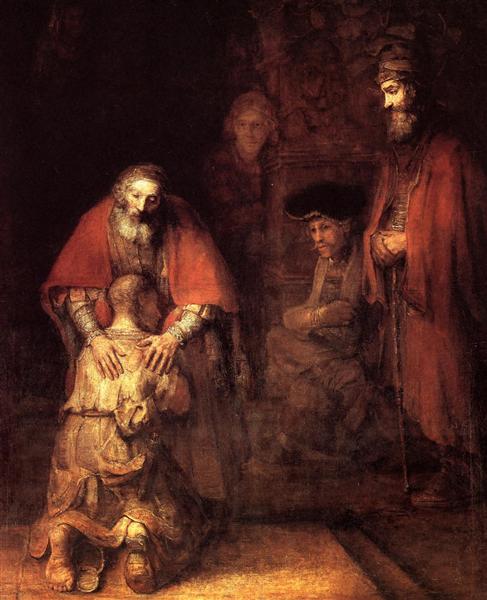
Light as emotion, not description. In 'The Return of the Prodigal Son', painted in the final years of his life, the hands of the old father rest on the ragged back of the kneeling son. The light falls on those hands. Nothing else in the painting matters.
Life and legacy
Rembrandt Harmenszoon van Rijn was born on 15 July 1606 in Leiden, the ninth child of a prosperous miller. Leiden was a university city, and Rembrandt briefly enrolled there before deciding, at around fourteen, that painting was the only thing worth doing. He apprenticed with the local painter Jacob van Swanenburgh for three years, then spent six crucial months in Amsterdam working under Pieter Lastman, who had himself studied in Rome and carried a serious knowledge of Italian Baroque composition back to the Netherlands.
By 1625, barely nineteen, Rembrandt was back in Leiden running his own workshop. His ambition was obvious from the start — he was painting large-scale history subjects, biblical scenes with many figures, when most artists his age were still grinding pigments. The early work is theatrical and a little overwrought, but already unmistakable. The Leiden period produced a series of small-scale works of astonishing emotional intensity.
In 1631 he moved permanently to Amsterdam, the most prosperous city in the world at that moment. Amsterdam's wealthy merchant class wanted portraits, and Rembrandt gave them the greatest portraits the Dutch Republic had ever seen. His fee quickly became the highest in the city.
In 1634 he married Saskia van Uylenburgh, the cousin of his art dealer. She was from a prosperous Frisian family and brought a significant dowry. She appears in dozens of his paintings of the 1630s — sometimes as a biblical queen, sometimes directly herself. They had four children; three died in infancy. Saskia died in 1642, aged twenty-nine, of tuberculosis, just months after 'The Night Watch' — his largest and most complex commission — had been delivered and caused a confused reaction from some of its patrons.
He became involved with his son Titus's nurse, Geertje Dircx, then separated from her acrimoniously — he had her committed to a workhouse in 1649 in a legal dispute over jewellery. He then began a relationship with Hendrickje Stoffels, a young woman who had come to work in his household. She bore him a daughter, Cornelia, in 1654. Though they never married (largely for legal reasons connected to Saskia's estate), Hendrickje was his companion for the rest of her life.
The financial disaster arrived in 1656. He had spent recklessly — buying art, antiquities, curiosities, weapons, and all manner of expensive props — and the mortgage on his large house on the Sint-Anthonisbreestraat had gone unpaid. He was declared insolvent. The bankruptcy proceedings of 1656 stripped him of almost everything: his house, his art collection, his etching press, his inventory. He was forced to sell the house where he had lived for nearly twenty years.
Hendrickje and Titus set up a formal art dealership, with Rembrandt as their employee, to protect his future earnings from creditors. He kept painting, kept making etchings, kept teaching. The late works — the 'Jewish Bride', the 'Syndics of the Drapers' Guild', the devastating self-portraits — are among the greatest paintings ever made. Hendrickje died in 1663. Titus died in 1668, just a year after marrying, aged twenty-seven. Rembrandt died on 4 October 1669, aged 63, in a rented house in the Jordaan district of Amsterdam. He was buried in an unmarked grave in the Westerkerk.
Five famous paintings
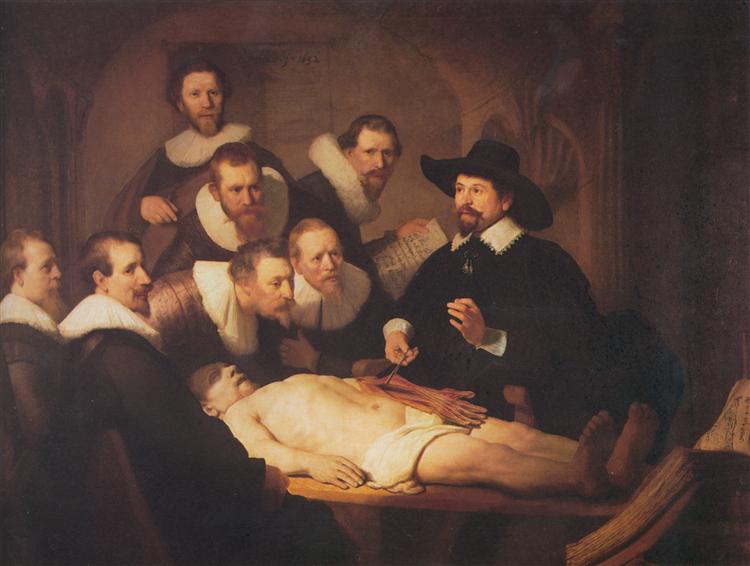
The Anatomy Lesson of Dr. Nicolaes Tulp 1632
Painted when Rembrandt was twenty-five and had just arrived in Amsterdam, this large canvas — 169 by 216 centimetres — was his opening statement to the most competitive art market in the world. Seven men in black watch the city's chief anatomist, Dr. Tulp, dissect the arm of a recently executed criminal. Rembrandt arranged them in a pyramid rather than a flat row, gave each face a different quality of attention, and flooded the scene with a warm raking light that came from nowhere classical anatomy taught. It immediately made him the most sought-after portrait painter in Amsterdam. The painting has hung in the Mauritshuis in The Hague since 1828.
The Return of the Prodigal Son 1669
Almost certainly the last large canvas Rembrandt completed before his death. The son kneels, back to us, in tattered clothing, his head shaved as a beggar's, and presses his face against the old man's chest. The father's hands rest on the son's back with a tenderness that is almost unbearable to look at directly — one hand firm and male, the other soft and maternal. The faces of witnesses stand in the shadows behind them, barely visible. The painting is enormous — 262 by 206 centimetres — and it is almost monochrome, built from warm browns and a single gold light. It has been in the Hermitage in Saint Petersburg since 1766.
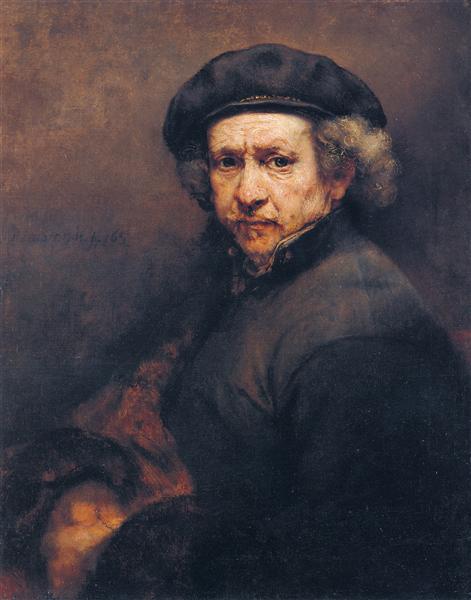
Self-Portrait (1659) 1659
One of the most celebrated of his ninety-odd self-portraits, made three years after the bankruptcy and a decade before his death. He poses in a chair, hands folded in his lap, and looks directly at the viewer. The face is open, undefended, without any of the theatrical posturing of the early self-portraits where he appeared in helmets and cloaks. The paint surface is extraordinarily rich — smooth in the background, built up in thick impasto ridges across the face. He was fifty-three. He looks exhausted and entirely without self-pity. It hangs in the National Gallery of Art in Washington D.C.
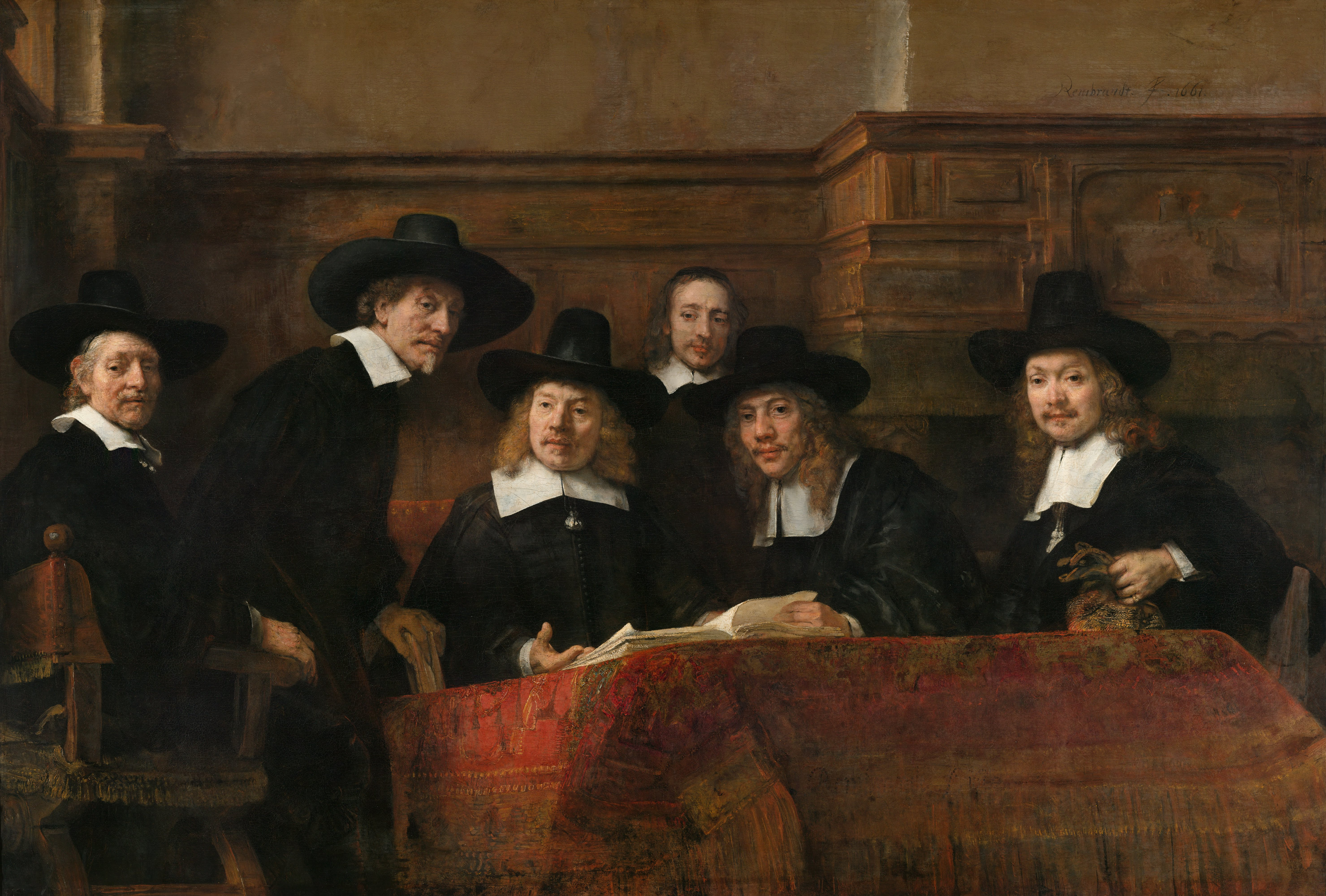
Syndics of the Drapers' Guild 1662
Five cloth inspectors and their servant sit around a table covered in a red Turkish rug. They have been examining a large book of accounts — one of them has just looked up, apparently interrupted mid-meeting by the viewer's arrival. The composition is so casual and so precise that it looks almost like a photograph. Rembrandt solved the eternal Dutch group-portrait problem — how to make six standing faces simultaneously interesting — by letting each man occupy his own psychological space. One is suspicious, one is merely polite, one is already returning to the book. The canvas was painted for the headquarters of Amsterdam's drapers' guild and still hangs in the Rijksmuseum.
The Slaughtered Ox 1655
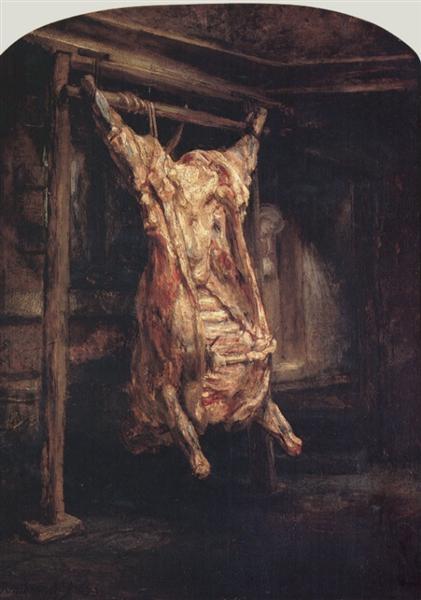
A raw carcass of a butchered ox, its legs spread and tied to a wooden frame, its split torso open and glistening. It is the most uncomfortable masterpiece in Dutch art. Rembrandt painted flesh — the actual matter of flesh — with a directness that no earlier artist had attempted. The colours range from near-white fat to deep purple-red muscle to brown of dried blood, and the impasto is thick enough to make the meat look three-dimensional. A woman peers around a doorframe at the back right, possibly the wife of a butcher, providing a small human scale to underline how enormous the carcass is. It hangs in the Louvre, where it has influenced Soutine and Francis Bacon.