Diego Velázquez
Court painter to Philip IV for thirty-seven years — and the painter every other painter has copied since.
Style and technique
Velázquez does something almost impossible: from three metres away, his paintings look like photographs; from thirty centimetres away, they look like abstract painting. Step closer and the velvet sleeve dissolves into a few lazy strokes of grey. Step back and the sleeve is there again, pressed and embroidered, with a tiny shadow at the cuff. Manet, three centuries later, called him 'the painter of painters' for exactly this reason.
The trick is alla prima — wet on wet — and a brushwork looser and faster than anything else in 17th-century painting. Most Baroque painters built their portraits up in patient layers of glaze. Velázquez worked the surface like a sculptor pushing wet clay. He often left whole sections almost unfinished — and the unfinished sections are the ones that look most photographic.
Four fingerprints make a Velázquez instantly recognisable.
Loose, painterly handling. Especially in the late paintings. Lace, fur, brocade, hair — all suggested rather than drawn.
Aerial perspective. He paints distance. Distant figures lose their edges; the air between you and them is something you can almost feel. He had been studying Titian his whole life and pushed Titian's atmospheric handling further than anyone before Manet.
Dignity for outsiders. He paints the court jesters, the dwarfs, the kitchen boys — and gives them the same gravitas as the king. There is no caricature, no humour at their expense.
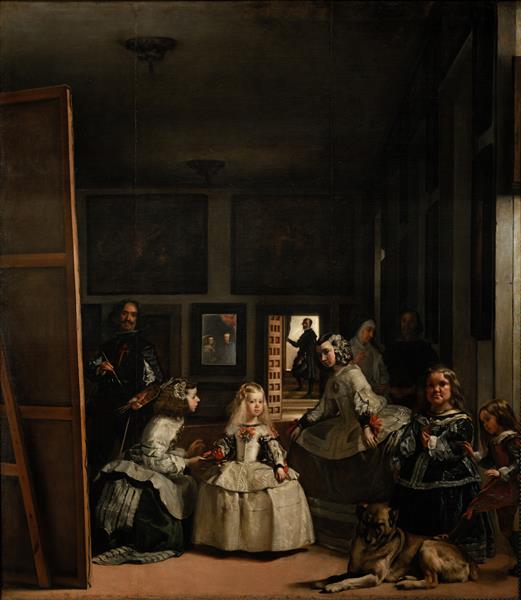
Mirrors, framing devices, cropped figures. Long before Degas or Manet, he was placing mirrors at the back of rooms, half-cropping figures at the edge of the canvas, and pretending the picture had been caught by accident. Las Meninas is the supreme example, but it is the logic of half his career.
He had no real students and no real school. He had something more useful: a lifetime job at the most powerful court in Europe, complete artistic freedom from his patron Philip IV, and almost forty years to think slowly. He travelled to Italy twice, met Rubens in Madrid, copied Titians in the royal collection, and spent the rest of his time observing, on the inside, the strangest court in Europe. Everything he learned ended up in the paintings.
Life and legacy
He was baptised Diego Rodríguez de Silva y Velázquez in Seville on 6 June 1599. His paternal family was of distant Portuguese origin and his maternal grandparents were Spanish Jews who had converted to Catholicism — a fact that, in 1599 Spain, was best forgotten. By Spanish custom he took his mother's family name as his stage name, and 'Velázquez' is what stuck.
He was apprenticed at twelve to Francisco Pacheco, a respected but uninspiring Sevillian painter and theorist. Pacheco realised quickly that the boy was already better than he was. Velázquez completed his apprenticeship in five years and, at eighteen, qualified as a master painter. He married Pacheco's daughter, Juana, the following year. They had two daughters, only one of whom survived to adulthood.
His early Sevillian paintings (1617–1622) are dark, low-keyed and rooted in Caravaggio's tenebrism, which Velázquez knew through Italian followers passing through southern Spain. He painted bodegones — tavern scenes with peasants, water sellers, fried eggs, copper pans — almost as if he were studying still life in the form of figure painting. 'The Water Seller of Seville' (1622) is the masterpiece of these years.
He was 24 years old when his protector at court, the Count-Duke of Olivares, arranged for him to paint a portrait of the young Philip IV. The king liked the result so much he forbade any other painter to portray him. Velázquez was named Painter to the King, given lodgings in the royal palace, and entered into a working relationship that would last 37 years until his death.
Philip IV was the most painted face of the 17th century. Velázquez painted him perhaps thirty times — as a young king at 19, as a soldier at 30, as a tired widower at 60, with the same long pale face, the long jaw, the slightly drooping eye. The two men, by all accounts, became close. The king visited the studio almost daily.
In 1628 Peter Paul Rubens came to Madrid as a diplomat and copied works from the royal Titian collection alongside the young Velázquez. Their conversations changed Velázquez. The next year, with the king's permission, he made his first long trip to Italy (1629–1631) — Genoa, Venice, Rome, Naples. He came back having absorbed Titian and Tintoretto deeply, and his painting loosened forever.
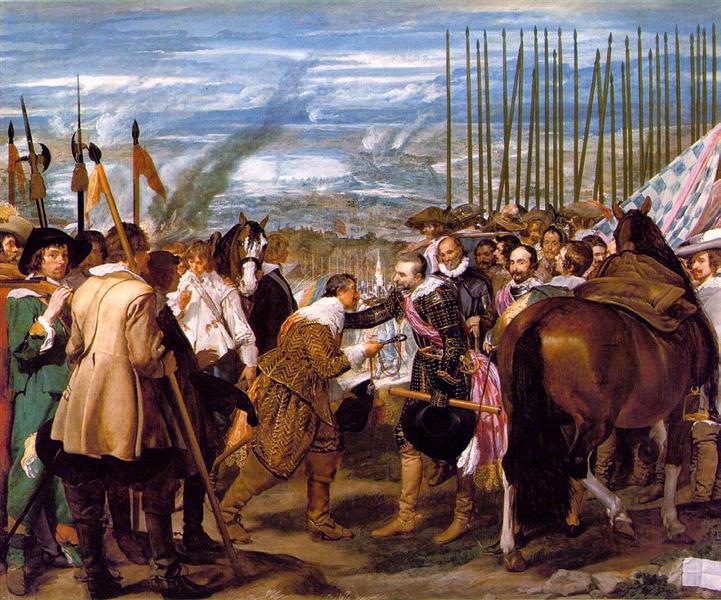
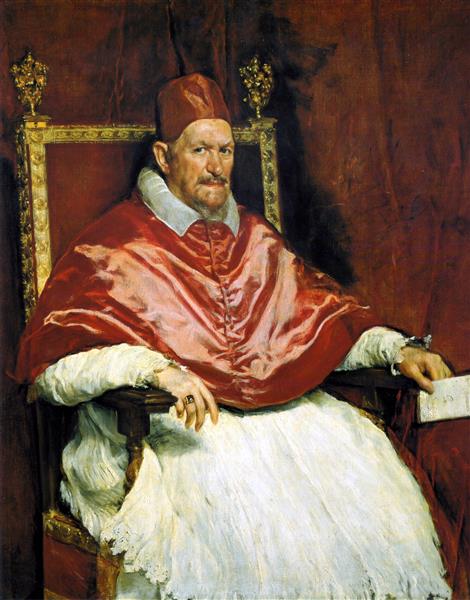
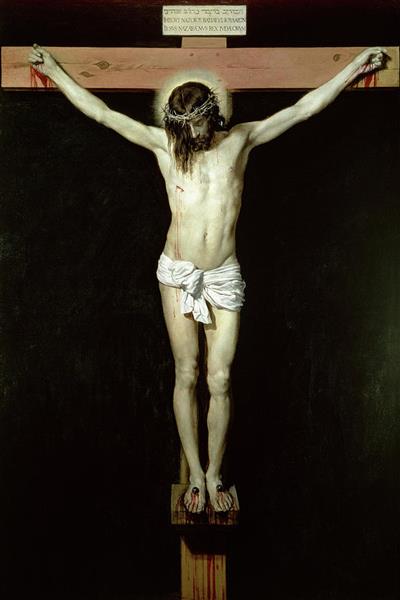
The 1630s and 1640s were the great public commissions: 'The Surrender of Breda' for the Hall of Realms, equestrian portraits of the royal family, the dwarfs and jesters of the court, the magnificent 'Christ Crucified' for a Madrid convent. Then, on a second Italian trip in 1649–1651, he painted in Rome the staggering portrait of Pope Innocent X — a painting the Pope famously called *'troppo vero'*, 'too truthful'. The pope kept it in a private corridor of the Doria Pamphilj palace. It is still there today.
Back in Madrid in 1656, he painted his masterpiece: Las Meninas. We are still arguing about who its real subject is — the little Infanta Margarita in the centre, the king and queen reflected in the mirror, the painter himself standing at his enormous canvas, or the viewer who has just walked into the room.
In 1659, after years of lobbying, he was knighted into the Order of Santiago — a vanishingly rare honour for a working painter. The cross of Santiago appears on his chest in Las Meninas; it was added to the painting after he was knighted. (Legend says the king himself painted the cross with his own hand, but no contemporary account supports this.)
In the spring of 1660 he was sent to organise the Spanish-French royal wedding on the border between the two kingdoms — endless logistics, days on horseback. He came back exhausted in late July. He fell ill with fever on 31 July and died on 6 August 1660, aged 61. His wife Juana died eight days later. They were buried together in the parish church of San Juan in Madrid, a building destroyed by Joseph Bonaparte in 1809. Their tomb has never been found.
Most of his roughly 120 surviving paintings are in the Museo del Prado in Madrid, by far the largest collection in the world.
Five famous paintings
The Water Seller of Seville 1620
Painted when Velázquez was 21, still in Seville, and already a master. An old water seller, in a torn brown robe, hands a glass of water to a young boy. A dark, unidentified figure between them sips quietly. The clay water-jugs in the foreground are painted with a precision a Dutch still-life painter would have envied — droplets of water beading on the surface, the cool grey-green of unglazed terracotta. The painting was bought by the Duke of Wellington from Joseph Bonaparte in 1813, and it now hangs in Apsley House, the Wellington Museum in London, looking strangely out of place in a Regency drawing room.
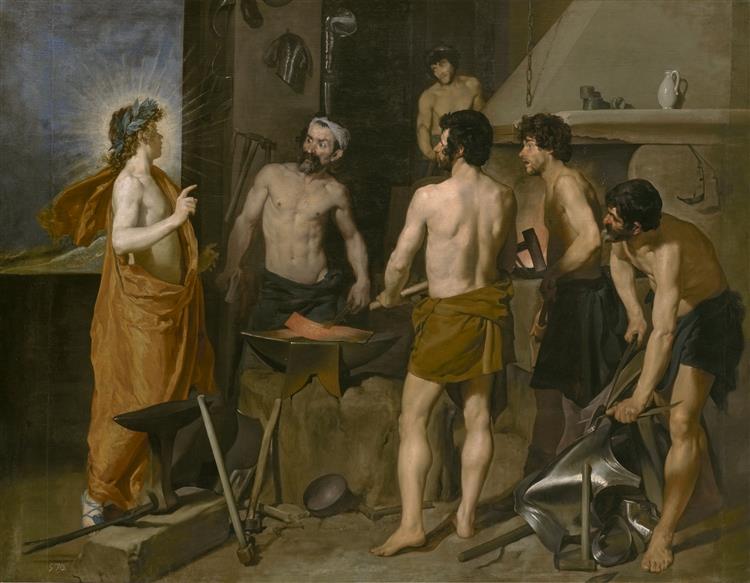
The Forge of Vulcan 1630
Painted in Rome during his first Italian trip, when Velázquez was 31 and absorbing Titian, Tintoretto and the Roman antique simultaneously. Apollo, golden, half-naked, with a laurel crown, walks into Vulcan's grimy workshop to break the news that Vulcan's wife Venus is having an affair with Mars. The Cyclopes, frozen mid-hammer-strike, are unmistakably real Sevillian blacksmiths he had been drawing for years. The light is Caravaggesque; the colour is Venetian; the dignity given to working men is pure Velázquez. The painting was bought back to Madrid and is now one of the centrepieces of the Prado.
The Surrender of Breda 1635
Commissioned for the Hall of Realms in the new Buen Retiro Palace in Madrid, this is the great Spanish history painting of the 17th century. The Dutch governor Justin of Nassau hands the keys of the city of Breda to the Spanish general Ambrosio Spínola after a ten-month siege in 1625. Spínola refuses to humiliate him. He places his hand on the Dutch governor's shoulder, almost gently, and bends slightly forward to receive the keys. The Spanish army's lances rise like a forest behind them; the picture is sometimes nicknamed 'Las Lanzas'. Velázquez never visited Breda — he relied on engravings and conversations with Spínola, who had become a friend. It hangs in the Prado.
Portrait of Pope Innocent X 1650
Painted in Rome during Velázquez's second Italian trip, in a few sittings in early 1650. The Pope — Giovanni Battista Pamphilj — is shown in a red velvet cape and white satin rochet, seated on a gilt throne. The face is shrewd, lined, almost angry. The eyes look not at the viewer but at someone slightly to the right, as if interrupted. The Pope's reaction was 'troppo vero' — 'too truthful'. He kept the painting in a private gallery, where it has hung in the Doria Pamphilj palace in Rome ever since. Three centuries later, Francis Bacon would obsess over the same painting and produce his series of 'Screaming Pope' canvases. Bacon never managed to see the original; he worked from a black-and-white photograph.
Las Meninas 1656
The last and the greatest of his paintings. The Infanta Margarita, aged five, stands in the centre of a high-ceilinged room in the royal palace, attended by two ladies-in-waiting (the meninas of the title), two court dwarfs, a sleeping mastiff, a chaperone and a guard. To the left, Velázquez himself stands at an enormous canvas with brush and palette, looking out at us. In the small mirror at the back of the room, half-cut by a doorframe, are the faces of King Philip IV and Queen Mariana — the people the painter is in fact painting, the people whose place we are standing in. It is a painting that simultaneously contains the painter, the painting, the subject, and the viewer in one impossible glance. The Infanta died at 21. The painting is roughly 3 metres tall by 2.7 metres wide. It hangs in the Prado, in a room of its own.