Paul Gauguin
He left France looking for paradise, and painted it with colours that didn't exist in paradise.
Style and technique
Gauguin's great innovation was using colour as a symbolic rather than descriptive system. His yellows, oranges, and deep blues do not reproduce what he saw; they translate what he felt about what he saw. The grass in his Tahitian landscapes is not the green of actual Tahitian grass; it is whatever shade of green carries the emotional charge of lushness, mystery, or spiritual weight that he needed at that point in the composition.
He arrived at this through the Impressionist approach — he studied with Pissarro in the late 1870s and painted alongside Cézanne — and then consciously rejected it. Impressionism for him was too tied to the visible surface of the world. He wanted to get behind the surface, to paint what he called 'the mysterious centres of thought' rather than the retinal data of sunlight on water.
His formal solution was derived partly from Japanese woodblock prints, partly from the Breton popular religious art he encountered in Brittany in the late 1880s, and partly from his own study of Polynesian and Aztec art. He moved towards flat planes of saturated colour separated by clear outlines, with minimal modelling and no cast shadows. The technique is called Synthetism or Cloisonnism; he shared its development with Émile Bernard.
Four things identify a Gauguin: flat planes of intense colour with minimal shadow, figures with the simplified solidity of carved objects, an atmosphere of ritual or spiritual weight even in everyday scenes, and the specific palette of Tahiti — the terracotta earth, the dense green, the particular quality of Pacific blue.
Life and legacy
Gauguin was born on 7 June 1848 in Paris, the son of a journalist and a Peruvian Creole woman. When he was one, his father died on a voyage to Peru; he and his mother lived in Lima for four years with her wealthy maternal relatives. He grew up partly Peruvian, partly French, and entirely comfortable with the idea that civilisation had multiple centres.
He went to sea at seventeen, spent five years in the merchant marine and then the French navy, and returned to Paris in 1871. He found work as a stockbroker's clerk with the firm of Bertin and rapidly rose to a comfortable middle-class position. He married Mette Sophie Gad, a Danish woman, in 1873. They had five children. He collected Impressionist paintings as investments and began painting as a hobby.
In 1883, aged thirty-five, he gave up his job to paint full time. This decision was not received well. Mette took the children and returned to Copenhagen. Gauguin followed briefly but could not work there; he returned to Paris alone and eventually, in 1886, to Brittany, where the ancient Catholic culture and the stark Breton landscape began to transform his painting from Impressionist naturalism into something else.
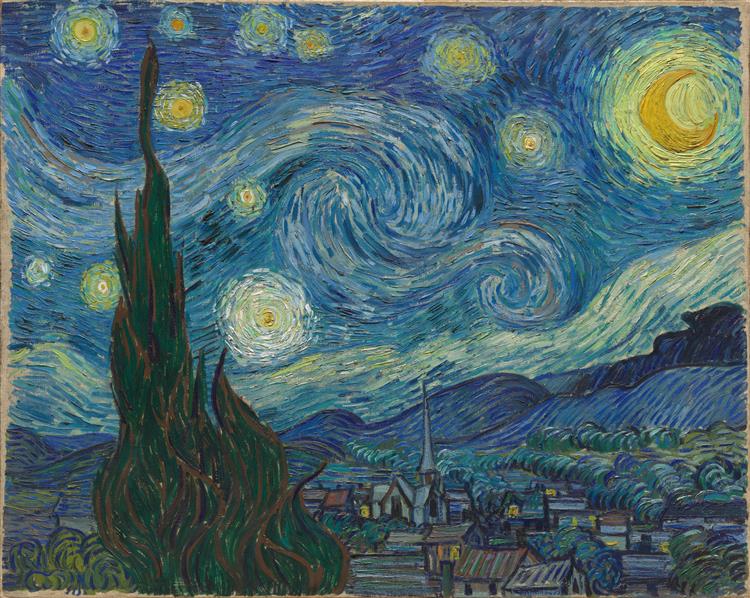
The winter of 1888–89 in Arles with Van Gogh was the most famous two months of his career. They had been planning a working collaboration for months; what followed was nine weeks of intense argument, mutual admiration, psychological crisis, and the night when Van Gogh cut off his own ear. Gauguin left immediately and never saw Van Gogh again.
In 1891 he sailed for Tahiti, having sold sixty-three paintings in a deliberate auction to raise the fare. He had constructed an image of the Pacific as an unspoiled paradise untouched by industrial capitalism — an image largely derived from travel literature rather than direct knowledge. The reality of colonial Tahiti was more complicated, but what he found there — the light, the colour, the bodies and faces of the Tahitian people, the layered mythological culture that he studied and partly invented — transformed his painting decisively.
His final years were financially desperate and physically painful: he contracted syphilis, broke his ankle in a brawl with a group of sailors, suffered multiple heart attacks, and spent months in hospital. In 1901 he moved to the Marquesas Islands, even further from France, hoping to find a more unspoiled environment. He died on 8 May 1903 in Atuona, on Hiva Oa, aged fifty-four. He had just been fined and sentenced to imprisonment for writing an anti-colonial newspaper article.
Five famous paintings
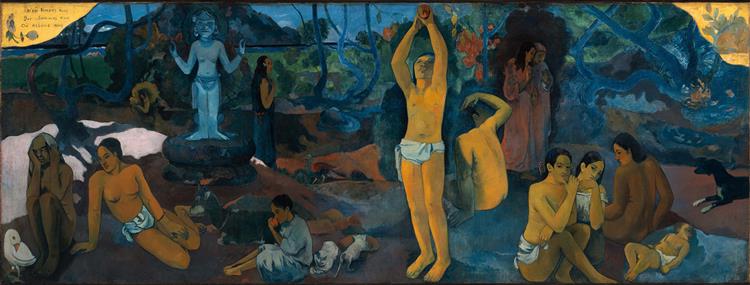
Where Do We Come From? What Are We? Where Are We Going? 1897
Gauguin's most ambitious single painting — nearly four metres wide — painted in a single sustained effort while he was simultaneously writing what he believed was his farewell letter to the world before attempting suicide. He survived the attempt. The painting moves from right to left through the stages of life: an infant in the right foreground, figures in the middle, an old woman at the left. A blue idol stands in the background. The painting is not an illustration of a philosophical thesis but a visual atmosphere of the questions themselves — birth, existence, death, the presence of the divine, the beauty and strangeness of the human body. It hangs in the Museum of Fine Arts in Boston.
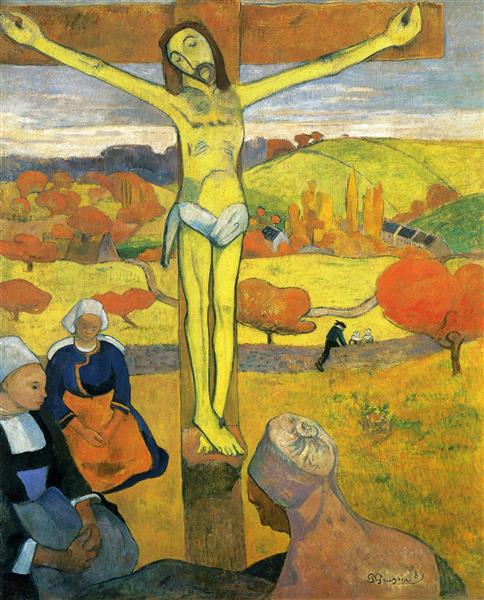
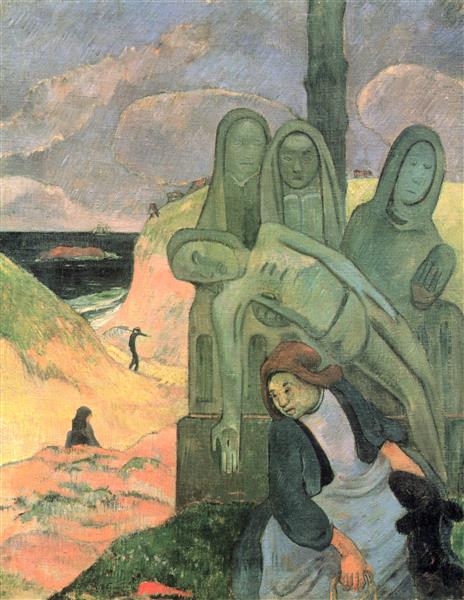
The Yellow Christ 1889
A defining statement of Synthetist painting, made in Brittany in 1889. A crucified Christ in a Breton autumn landscape — the yellow of the trees has infected the entire painting, including the figure on the cross — is attended by three Breton women in white coifs praying at its foot as if it were a roadside shrine. The colour has no descriptive purpose: no flesh is that flat yellow-gold. The outlines are thick and clear. The effect is of a painting that is simultaneously a religious image and an argument about how religious images work: how flat colour and simplified form create spiritual atmosphere. It hangs in the Albright-Knox Art Gallery in Buffalo.
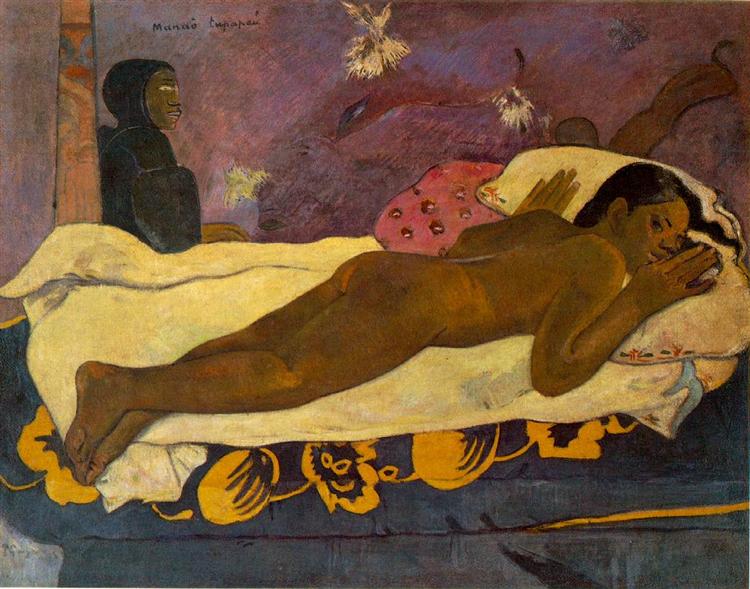
The Spirit of the Dead Keeps Watch (Manao Tupapau) 1892
A young Tahitian woman lies face down, naked, on a white bed; behind her, in the darkness, sits the tupapau — the spirit of the dead — a small dark figure with a white face and closed eyes. Gauguin described the painting's genesis in his journal: he had come home late to find his companion terrified in the dark, and he had painted her fear and his own meditations on death and spirit belief. The dark background is not shadow but phosphorescent matter, he said — the substance from which the tupapau is made. The painting is in the Albright-Knox Art Gallery in Buffalo.
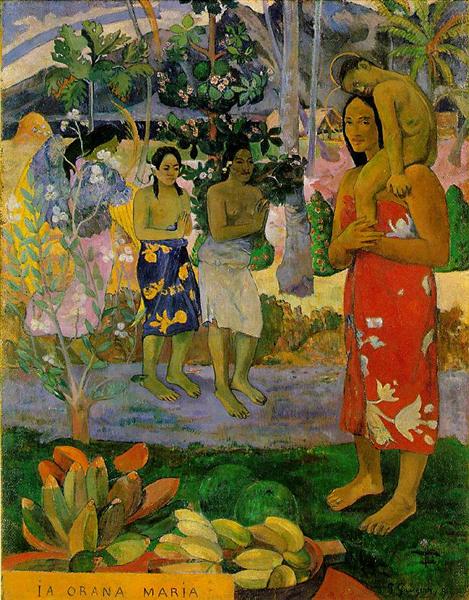
Ia Orana Maria (Hail Mary) 1891
One of the first major Tahitian paintings, showing a Tahitian woman — the Virgin Mary, identified by her halo — holding a child on her shoulder while two women in pareus make a gesture of prayer. Behind them, the figure of an angel and a landscape of dense tropical foliage. The painting transposes a Western religious subject onto Polynesian bodies and landscape with a directness that was characteristic of Gauguin's approach: he was not illustrating the Annunciation but arguing that the divine can take any human form. The colour — the terracotta earth, the deep green, the coral and rose of the figures — announces the Tahitian palette that would define the rest of his career. It hangs in the Metropolitan Museum of Art.
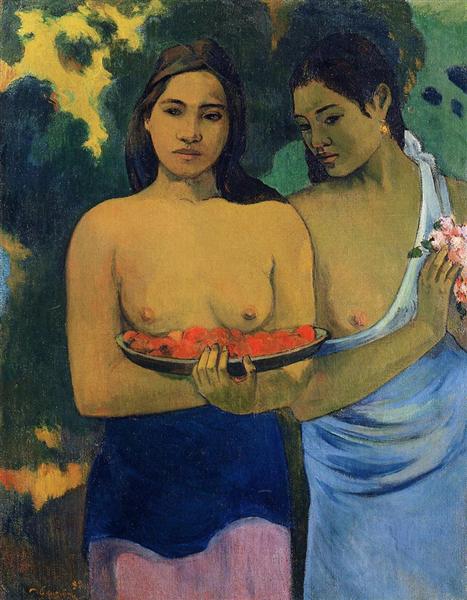
Two Tahitian Women 1899
Two women stand together, one holding a tray of flowers and fruit in her cupped hands, the other bare-breasted and looking directly at the viewer. The composition is frontal and hieratic — the figures have the solidity of carved relief, their bodies simplified into broad planes of warm colour. The background is a flat, deep pink. Gauguin is combining his Tahitian subject matter with the influence of ancient Egyptian and Cambodian art that he had encountered in reproductions — the frontality, the deliberate simplification of anatomical detail, the combination of profile and frontal view. It hangs in the Metropolitan Museum of Art in New York.