Hannah Höch
The Berlin Dadaist who picked up a pair of scissors, cut the Weimar Republic out of its own magazines, and reassembled it into a furious, joyful new woman.
Style and technique
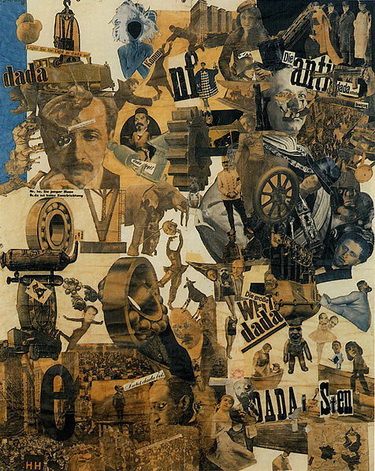
Höch is one of the inventors of photomontage — the technique she and Raoul Hausmann claimed to have discovered together on a Baltic holiday in 1918, when they noticed how soldiers' studio portraits had been pasted by hand into commemorative prints sent home by the army. She took the idea back to Berlin, sat down at a kitchen table, and made it into the central language of Dada: scissors, paste pot, and the endless flood of cheap illustrated magazines the Weimar Republic was producing — Berliner Illustrirte Zeitung, Die Dame, Uhu, Der Querschnitt — full of film stars, tribal masks, racing cars, ball bearings, ballet dancers and the legs of typists.
Her pictures are not collages in the gentle Cubist sense. They are surgical assemblages in which a single image is built from thirty or fifty cut fragments, scaled wildly against each other — a tiny dancer balanced on a giant mechanical eye, a beauty-pageant smile grafted onto a Bauhaus diagram, the head of Käthe Kollwitz fused to the dress of a chorus girl. The white paper between the cuttings is part of the composition. The seams are never hidden. You are meant to see the wound where one world has been stitched to another.
Four habits make a Höch unmistakable.
Cut typography as image. Words and letters from headlines drift through her compositions as visual matter, not as captions. The phrase 'Dada' itself appears as a found object, scissored out of a printer's drawer.
The New Woman as subject. Her great theme is the Neue Frau — the short-haired, wage-earning, cigarette-smoking woman the Weimar press both celebrated and mocked. She splices ballerinas to bricklayers, pageant queens to politicians, and asks the magazines to look at what they have built.
Ethnographic juxtaposition. From 1924 onwards she set images of African, Oceanic and Asian masks from the Berlin ethnographic museums against European fashion plates, in a long series — 'From an Ethnographic Museum' — that interrogates colonial looking decades before the word existed.
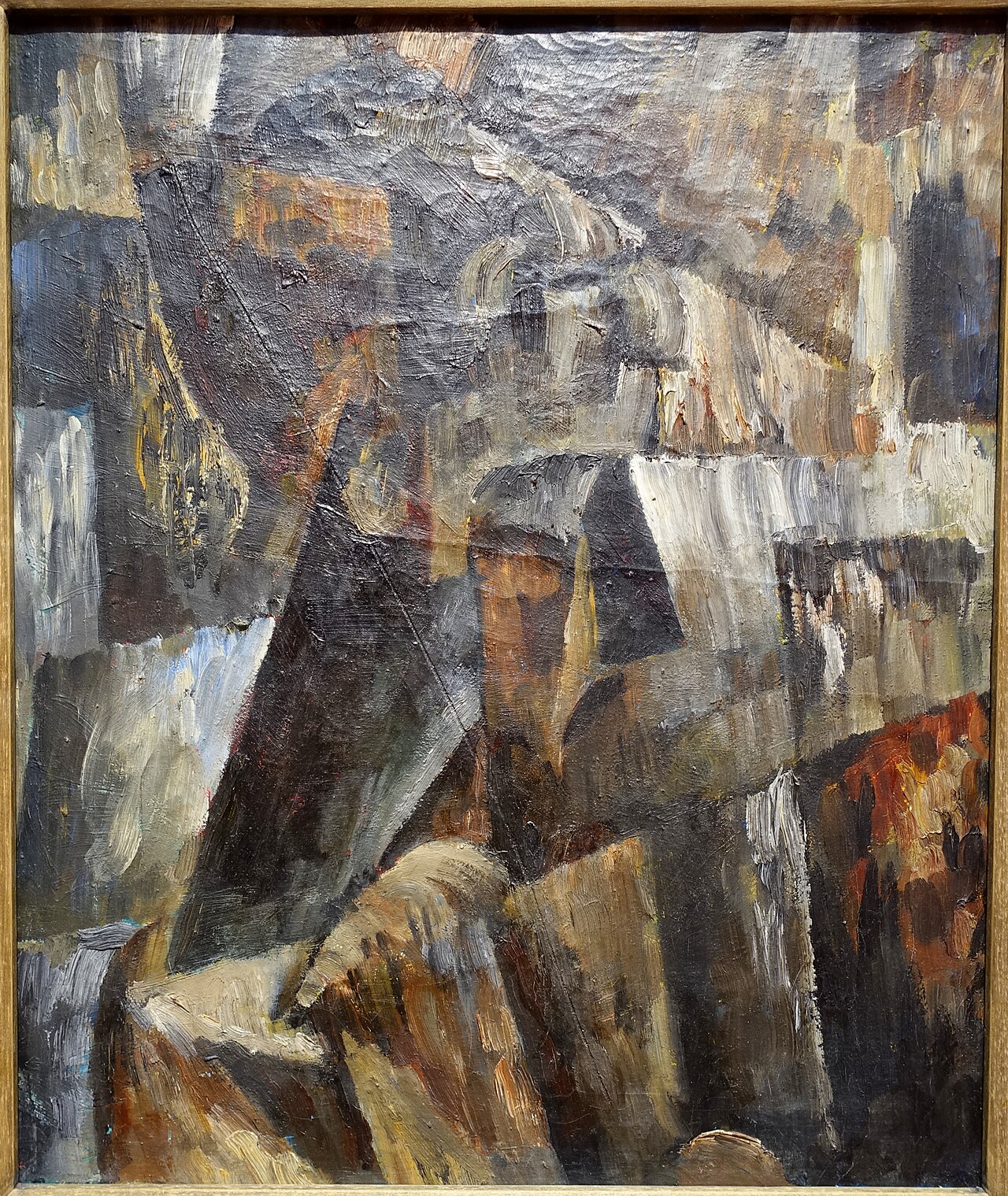
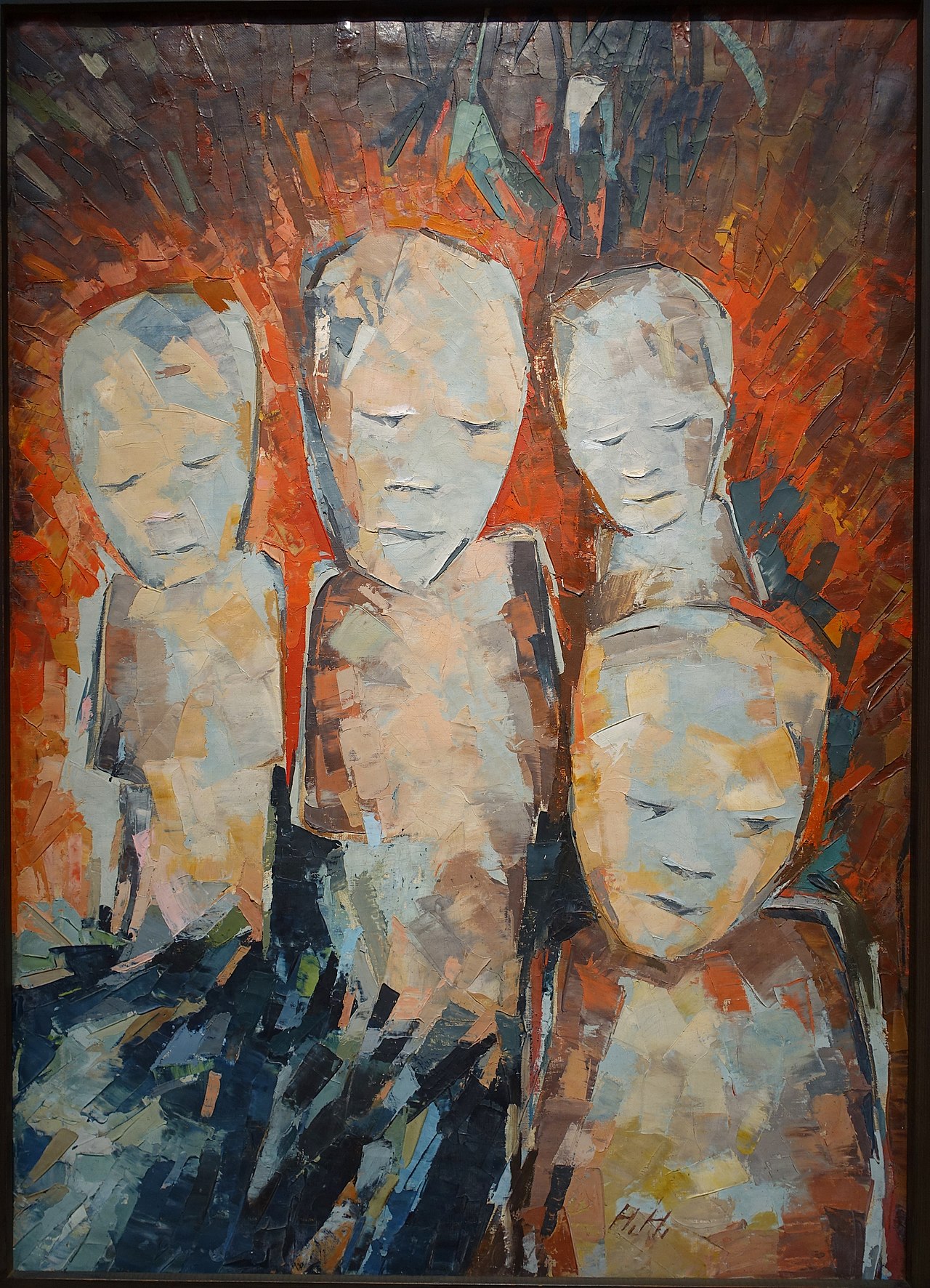
Oil paint as a parallel laboratory. Alongside the photomontages she painted in oil, all her life. The paintings are quieter, often more figurative, sometimes openly grotesque — flat-eyed women on dance floors, machine-bodied couples, dream-births from a Surrealist register. They are the photomontages slowed down to half speed, made with the hand instead of the blade.
Life and legacy
She was born Anna Therese Johanne Höch on 1 November 1889 in Gotha, a small Thuringian town in central Germany, the eldest of five children of a comfortable middle-class family. Her father Friedrich was an insurance company supervisor, her mother Rosa an amateur painter who first put a brush in Hannah's hand. Her schooling was interrupted at fifteen when she was taken out of class to help raise her youngest sister, a delay she resented all her life and that gave her, she said, the patience for very small scissors.
In 1912 she escaped Gotha for Berlin and enrolled at the Kunstgewerbeschule in Charlottenburg, the school of applied arts, where she studied glass design under Harold Bengen. The First World War interrupted everything: she returned briefly to Gotha to work in a Red Cross hospital, then came back to Berlin in 1915 and entered the Lehranstalt des Kunstgewerbemuseums to study graphic art with Emil Orlik. That same year, at an exhibition opening, she met Raoul Hausmann, the Austrian-Bohemian writer-artist who would become her lover, her co-conspirator, and one of the great burdens of her life. He was married. He stayed married, in a churning open arrangement, for the seven years of their relationship.
From 1916 to 1926 she earned her living at the Ullstein Verlag, the largest publishing house in Berlin, in the handicrafts department. She designed knitting and embroidery patterns for women's magazines like Die Dame and Praktische Berlinerin. The job was the secret engine of her art. She handled the mass-produced photographic image all day, every day — as raw material, as production waste, as something cheap and replicable. The same printed bodies that filled the magazines on her drawing board would, in the evenings, be cut up on her kitchen table.
In 1918 she joined the Club Dada Berlin through Hausmann. The group — Richard Huelsenbeck, George Grosz, John Heartfield, Wieland Herzfelde, Johannes Baader and Hausmann himself — was the most political wing of international Dada, a circle of furious anti-war, anti-bourgeois, anti-Expressionist agitators in a city still reeling from defeat and revolution. Höch was the only woman taken seriously inside it, and only barely. When the First International Dada Fair opened in June 1920 in Otto Burchard's gallery on Lützowufer, Grosz and Heartfield tried to exclude her. Hausmann had to threaten to withdraw before they grudgingly accepted her giant photomontage 'Cut with the Kitchen Knife Dada through the Beer-Belly of the Weimar Republic' (1919), now in the Neue Nationalgalerie Berlin — a square metre of cut Weimar press in which Einstein, Marx, Lenin, the dancer Niddy Impekoven and a map of countries with women's suffrage all collide.
In 1922 she finally broke with Hausmann, exhausted by his demands and his refusal to leave his wife. Four years later, in 1926, she met the Dutch writer Til Brugman in The Hague. The two women lived together openly as a couple, first in The Hague and then from 1929 in Berlin, until 1935. Those nine years are her most prolific. She produced the great series 'From an Ethnographic Museum' (begun 1924, continued through to 1930), which sets fashion-magazine bodies against masks from the Königliches Museum für Völkerkunde, and she travelled — to Paris, where she met Mondrian and Arp, and to the Netherlands, where Brugman's literary circle adopted her.
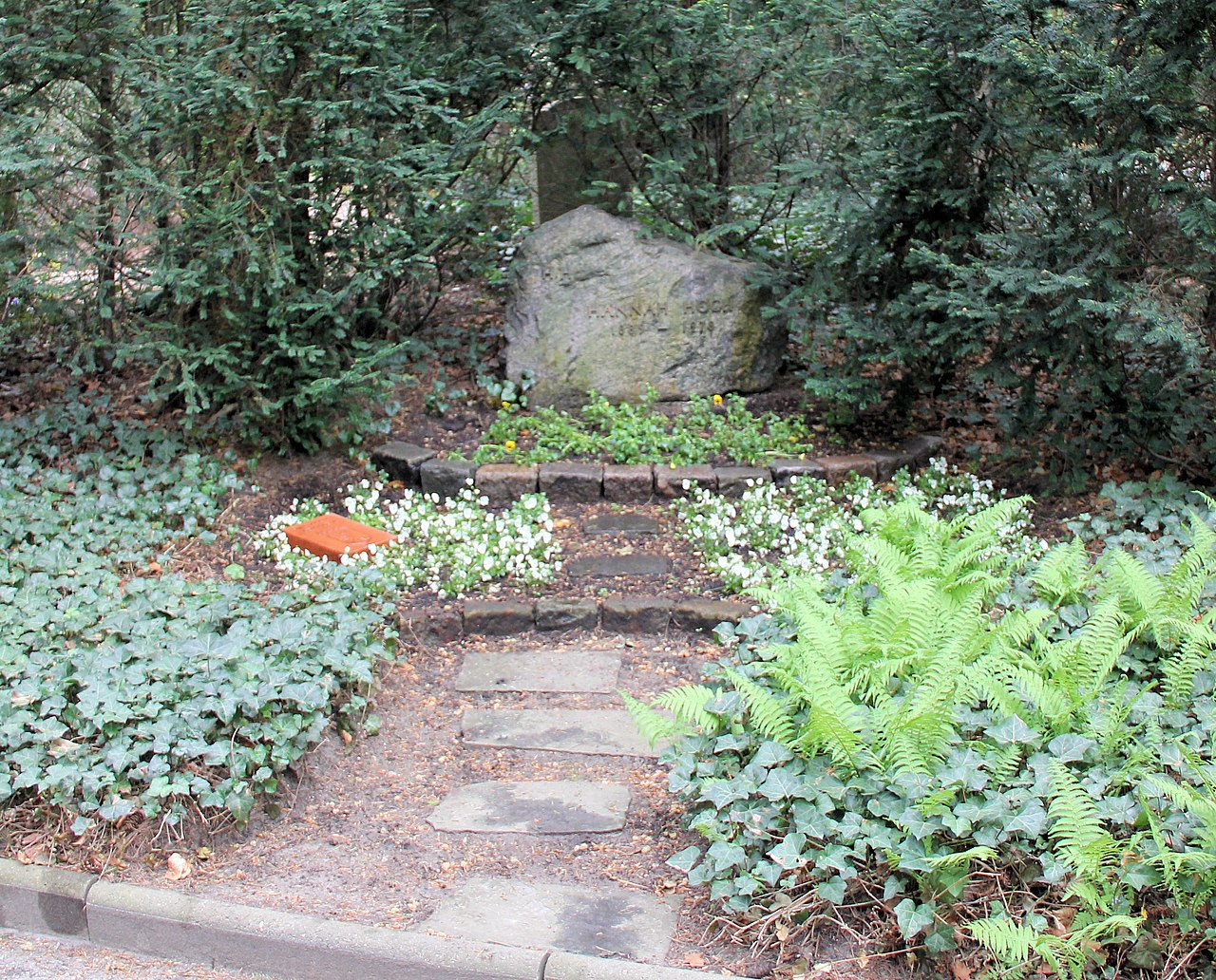
Then came 1933 and the Nazi seizure of power. Her work was branded 'degenerate' ('entartet'); she was put on the Reich Chamber of Culture's blacklist in 1937, banned from exhibiting and effectively silenced. In 1939 she bought a small house with a garden in Berlin-Heiligensee, on the city's far north-western edge, and quietly buried her career inside it. In a wooden garden shed and the cellar of the house she hid her own banned modernist works, plus correspondence, books and pieces by Schwitters, Mondrian and other condemned artists, throughout the war. The shed survived. So did she — alone, fed largely by her vegetable garden, ignored by the regime, while Berlin burned.
After 1945 she came slowly back. She kept making photomontages and oil paintings into her late seventies, increasingly recognised as a founder of a technique that the postwar avant-garde — Pop, the Situationists, feminist art of the 1970s — was busy rediscovering as if it were new. Major retrospectives in Berlin (1971) and Paris restored her to international view in her last years. She died in her Heiligensee house on 31 May 1978, aged 88. The garden, the shed, and the archive she had hidden there are now part of the Berlinische Galerie.
Five famous paintings
Dancing into the Dark 1919
Painted in oil in 1919 — the same explosive year as the photomontage 'Cut with the Kitchen Knife' — and now in the Germanisches Nationalmuseum in Nuremberg, this small canvas shows two flattened, doll-like figures locked in a dance against a dim, almost theatrical ground. Their faces are blanks; their bodies tilt at the same precarious angle as the chorus-line legs Höch was clipping out of Berlin magazines that winter. The picture is, in effect, the photomontage's twin painted slowly: where 'Cut with the Kitchen Knife' detonates the Weimar press across a square metre of paper, 'Dancing into the Dark' freezes one moment of its anxious nightlife in oil. Berlin in 1919 was a city of sailors' uprisings, beer-hall politics and dance halls full of war widows. Höch — newly inside the Club Dada Berlin with Hausmann, Heartfield and Grosz — paints the dance not as glamour but as mechanism: two stiff puppets driven by music neither they nor we can hear. The flat, almost folk-art handling already announces the Neue Sachlichkeit sobriety that German painting will adopt over the next decade.
Resignation 1928
An oil from 1928 in the Germanisches Nationalmuseum, Nuremberg, painted at the height of her partnership with Til Brugman in The Hague. A single seated female figure — heavy-lidded, hollow-cheeked, hands folded in her lap — fills the canvas in a flat, almost icon-like frontality. The colour is drained: ochres, browns, a single dim red. The painting belongs to the same investigation as her photomontage cycle 'From an Ethnographic Museum' (begun 1924), in which Höch was splicing European fashion bodies onto African and Oceanic masks to interrogate what the Weimar magazines were teaching their readers to see. Here the question is turned inward: the Weimar Neue Frau — the emancipated, wage-earning, short-haired woman the press celebrated and mocked — appears not triumphant but exhausted, staring past the viewer into the middle distance of an economy already cracking. A year later the Wall Street Crash would arrive in Berlin. Höch, working in oil rather than scissors, slows the photomontage's speed to a single sat figure and lets the silence around her do the political work.
Man and Machine 1921
An oil of 1921, now in the Germanisches Nationalmuseum, Nuremberg, and one of the clearest answers to the question Höch was asking on paper at the same moment: what happens to the human body when industrial photography takes it apart? Two figures — a man, a machine, or a man becoming machine — are interlocked in the centre of the canvas in flat, signboard colour. The body is built out of segments that look as if they had been cut and reassembled, exactly as in her contemporary photomontages, but here the cuts are made with the brush. The painting is in dialogue with the Berlin Dada obsessions of Hausmann, Grosz and Heartfield with the prosthetic war veteran, the typist welded to her machine, and the new mechanised proletarian body. Höch's particular contribution is the ambiguity of gender: man and machine, but also potentially woman and machine, sliding through one another. Painted in the last full year of her relationship with Hausmann, before their final break in 1922, it has the temperature of a relationship being scissored apart from the inside.
Birth 1924
Oil on canvas, 1924, Germanisches Nationalmuseum, Nuremberg, painted in the same year that Höch began her great photomontage cycle 'From an Ethnographic Museum'. A figure — half newborn, half ancestral mask — emerges in the centre of the painting against a flat, dreamlike ground that owes as much to Surrealism (de Chirico, then very fresh, was being shown in Berlin) as to the Neue Sachlichkeit sobriety of her German colleagues. Höch had no children, and never wanted them; her lover Raoul Hausmann had insisted that 'the new woman' should remain free of motherhood, and she had carried two pregnancies to abortion during their seven-year relationship. The painting is unsentimental: birth here is emergence, not a Madonna scene, and the body coming into the world wears the same masklike face as the African and Oceanic objects she was photographing in the Berlin ethnographic museums for the parallel paper series. It is one of her most quietly autobiographical works — a meditation, in slow oil, on what the Weimar Neue Frau was being permitted to bring into the world.
Creatures 1928
Oil on canvas, 1928, Germanisches Nationalmuseum, Nuremberg, painted in The Hague during her partnership with Til Brugman. A small congregation of strange beings — part-human, part-animal, part-puppet — populates the canvas in flat, weightless space. The handling is closer to Paul Klee than to Berlin Dada: a quiet, Surrealist menagerie rather than a political assault. By 1928 Höch had been making the photomontage series 'From an Ethnographic Museum' for four years, and the painting carries that series' fascination with hybridity into oil — the splice between species, between cultures, between the magazine and the museum. The 'creatures' are sometimes read as a coded portrait of her queer Hague household with Brugman, in which two women lived as a couple at a time when German law was tightening around homosexuality. Painted seven years before the Nazi rise to power forced her back to Berlin and into internal exile, it is one of the last works in which her imagination is allowed to play freely; the 'degenerate art' label of 1937 is already on the horizon.