Katsushika Hokusai
The obsessive Edo master who reinvented himself thirty times and gave the world its most recognisable wave.
Style and technique
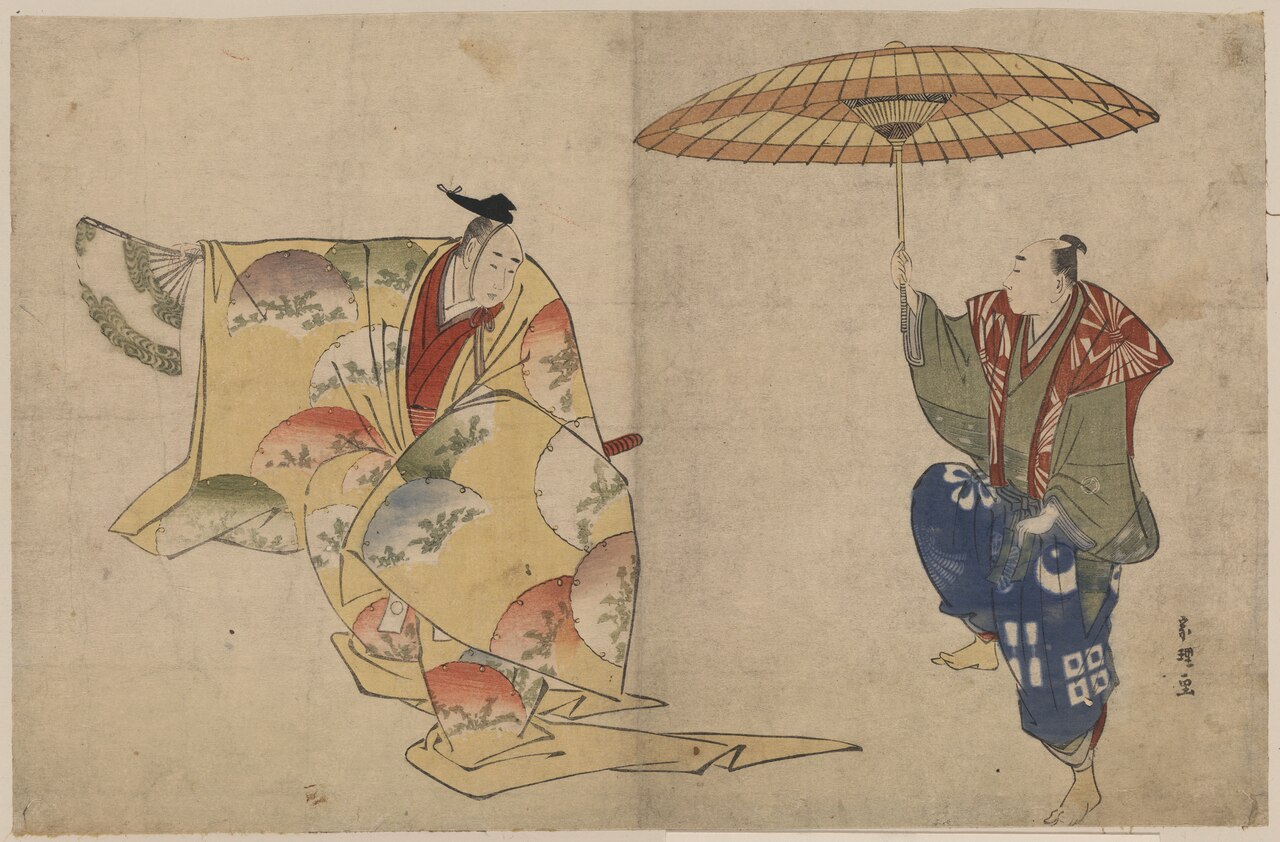
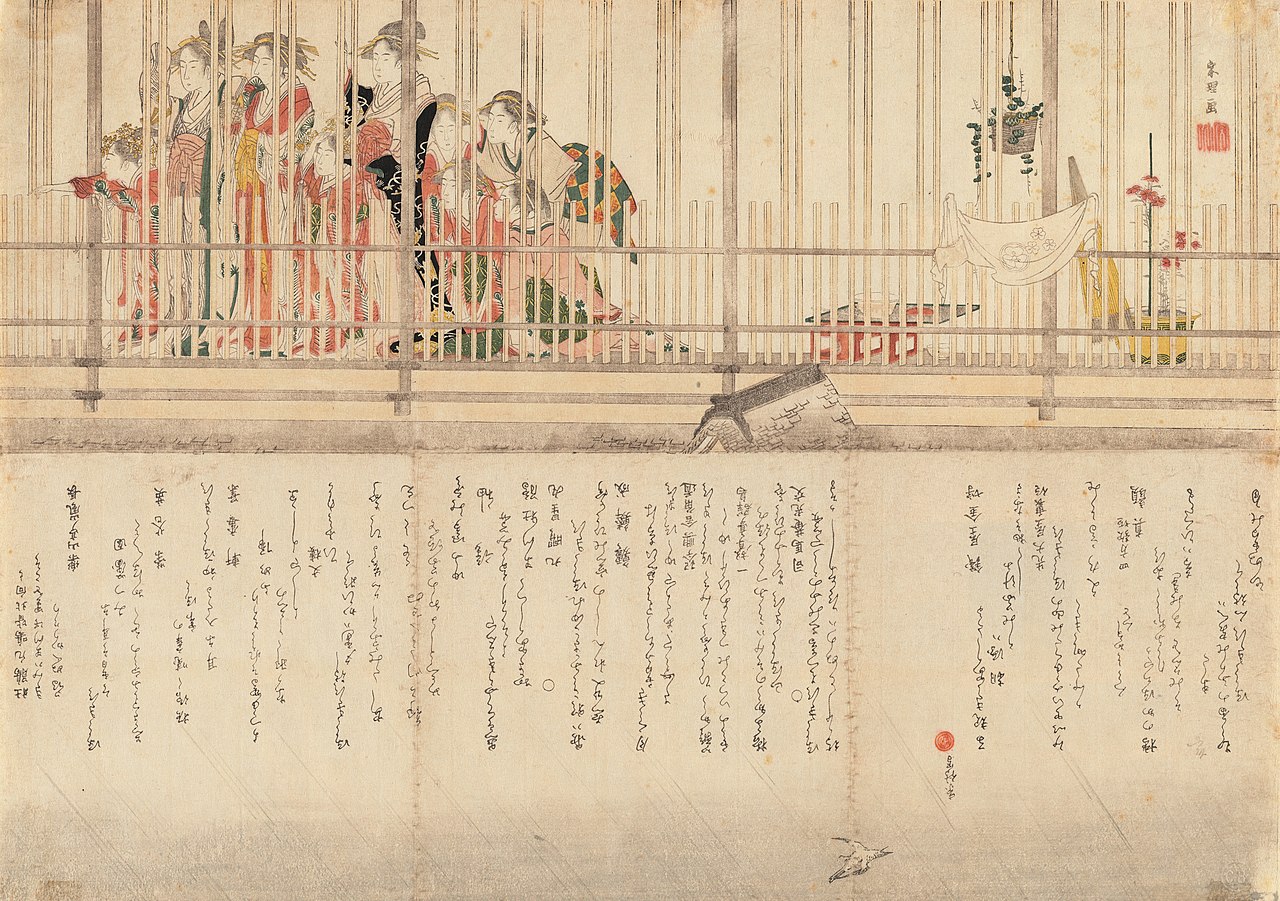
Hokusai approaches the world as if the act of drawing were itself a form of breathing — necessary, continuous, never finished. In a career spanning more than seven decades he produced an estimated 30,000 works: woodblock prints, illustrated books, single-sheet surimono, ink paintings on silk, quick studies of wrestlers, ghosts, flowers, waves, birds, and the flanks of a volcano glimpsed between cedar trees. No other artist in the Western or Eastern canon attempted so much, revised so relentlessly, or wore his own name out so deliberately. He changed his artist name approximately thirty times — from Shunrō to Sōri to Hokusai to Taito to Iitsu to Manji — not from whim but from conviction: each new name marked a fresh beginning, a shedding of habit, a wager that the best work was always still ahead.
The technical foundation is ukiyo-e woodblock printing, a collaborative craft in which the artist supplies the design, a block-cutter traces and carves it into cherry wood, and a printer builds the image in successive layered impressions — one block per colour, each requiring precise registration on dampened mulberry paper. At its most refined, a single print demanded a dozen or more blocks. Hokusai pushed this system harder than any predecessor: he exploited the subtle grain of the wood, experimented with bokashi (gradated tone on the block itself), and embraced the then-newly available Prussian blue — a synthetic pigment imported from Europe — as the spine of his late landscape palette. Prussian blue resisted fading in sunlight, held clean tonal gradations from near-black to pale aquamarine, and gave the Thirty-Six Views their unmistakable cold clarity.
Mount Fuji is the fixed star around which the whole system revolves. In the Thirty-Six Views series (begun c. 1830, expanded to forty-six prints), Fuji appears from every province, in every season and weather, glimpsed between a cooper's barrel, framed by a wave's claw, mirrored in a sake cup, or barely visible as a pink smudge above morning mist. The mountain is constant; the human world in front of it is perpetual motion — barrel-makers, porters, pilgrims, fishermen, ferry passengers, kite-flyers. This tension between the eternal and the momentary is the engine of his best compositions.
His compositional instinct is insistently diagonal and centrifugal. Where Chinese landscape convention placed the eye in the middle distance and let it travel inward, Hokusai pushes elements to the edge of the frame, tilts the horizon, plunges the viewpoint from above or below. The Great Wave is the supreme demonstration: a concave wall of water fills the upper two-thirds of the picture, its foam-claws reaching toward a tiny, inverted Fuji at lower right. The eye enters at the wave's crest, falls toward the boats below, and is hurled back up — the image does not permit rest.
The Manga sketchbooks — fifteen volumes published between 1814 and 1878, the last three posthumously — represent the other pole of his practice: pure observation, disciplined randomness, a world encyclopedia of pose and gesture. Wrestlers grapple, cooks slice fish, acrobats bend impossible arcs, demons grimace, ferns uncoil, rivers fork. European artists who encountered the volumes after they arrived in France in the 1860s — among them Degas, Monet, and Van Gogh — treated them as a revelation of what drawing could do when liberated from the single-point system of Western academy. The wave of Japonisme that swept European modernism from the 1860s onward flows directly through these pages.
He worked until the morning of his death in 1849, aged eighty-eight, reportedly asking only for five more years.
Life and legacy
He was born on 31 October 1760 in Honjo, a working-class district of Edo (present-day Tokyo), into a family of artisans. His father, Nakajima Ise, was a mirror-polisher who supplied lacquered frames to the Tokugawa shogunate. Nothing about the household suggested a future master: there was no inherited wealth, no cultivated patron, no tradition of painting. The boy's given name was Tokitarō. He later claimed to have begun drawing at the age of six, tracing shapes in the dust.
At fourteen he was apprenticed to a wood-engraver, learning the craft of block-cutting from the inside — the grain of the cherry wood, the resistance of the gouge, the way a line thickens and thins depending on the angle of the blade. It was the best possible education for a printmaker: he would spend his career exploiting and subverting the limits of a medium he understood at its physical root. At eighteen he entered the studio of Katsukawa Shunshō, the leading designer of actor portraits in Edo, and adopted his first professional name: Katsukawa Shunrō. Under Shunshō he produced yakusha-e (actor prints) in the established Katsukawa style, technically assured but not yet distinctive.
Shunshō died in 1793, and Hokusai was shortly afterward expelled from the Katsukawa school — reportedly for studying with a rival, the Kanō-school painter Sumiyoshi Hiroyuki. The expulsion was, in retrospect, the making of him. Untethered from a house style, he began to absorb everything: Chinese painting manuals, Dutch copper engravings smuggled into Nagasaki, European perspective systems filtered through import books, the Rinpa school's decorative flatness, the Kanō school's ink-brush disciplines. He changed his name to Sōri, then to Hokusai — meaning roughly 'North Studio', a reference to the Big Dipper constellation — and began producing the surimono (privately commissioned luxury prints) and illustrated fiction that would first establish his reputation outside the actor-print market.
The great middle decades of his career, from roughly 1800 to 1820, produced the Hokusai Manga — the fifteen-volume encyclopaedia of drawing that began as a set of instructional templates for students in Nagoya and grew into something entirely different: a taxonomy of the visible world, arranged not by subject but by graphic energy. Volume One appeared in 1814. Readers found it unlike any illustrated book they had seen: two figures on each page, brushed with confident asymmetry, the bodies alive with implied motion, the backgrounds often absent entirely so that only the action remained. European artists who encountered the volumes decades later responded to exactly this quality — the economy, the vitality, the absolute refusal of the rhetorical pose.
In 1829, at the age of nearly seventy, Hokusai changed his name again — to Iitsu — and began work on the project that would define his reputation across two centuries: Thirty-Six Views of Mount Fuji (Fugaku Sanjūrokkei). The series was published in installments from approximately 1830 to 1832, expanding to forty-six prints as public demand outran the original plan. Each print showed Fuji from a different province, at a different hour, in different weather, with different foreground activity — but the mountain itself, rendered in Prussian blue and grey-green, remained compositionally stable, a fixed point around which Japan moved. The series sold out in multiple editions within months.
Among its forty-six prints, two became the most reproduced images in Japanese art history: The Great Wave off Kanagawa (c. 1831), in which a cresting ocean wave frames a miniature Fuji at lower right; and Fine Wind, Clear Morning (Red Fuji, c. 1830–32), in which the mountain turns crimson at dawn against a sky of Prussian blue. The Great Wave alone has been reproduced on more objects than any other work of visual art in the world.
Financial catastrophe ran parallel to artistic triumph throughout his life. Hokusai was constitutionally incapable of managing money — he moved house at least ninety-three times, often to escape creditors, and was declared bankrupt on multiple occasions. He relied on the generosity of publishers, students, and his devoted youngest daughter, Katsushika Ōi, herself a skilled painter, who nursed him through illness, managed his domestic affairs, and — later historians would argue — collaborated on some of the late paintings.
In his seventies he began the Hundred Views of Mount Fuji (Fugaku Hyakkei), a three-volume ink-and-grey-wash series of denser, more meditative Fuji images published 1834–35, and continued producing single-sheet masterworks including the Large Flowers series and the Waterfalls series, both of comparable technical brilliance to the Thirty-Six Views. He changed his name for the last time, to Manji — meaning 'ten thousand things' — at the age of seventy-five, and signed his late work with this name alongside the notation: 'the old man mad about drawing'.
He died on 10 May 1849 in Edo, aged eighty-eight, reportedly during a cholera epidemic that was sweeping the city. His last documented words, according to a contemporary account, were: *'If only Heaven will give me just another ten years — just five more years — then I could become a real painter.'* He was buried in the Seikyo-ji temple in the Asakusa district of Edo. He had been drawing for more than eighty years.
Five famous paintings
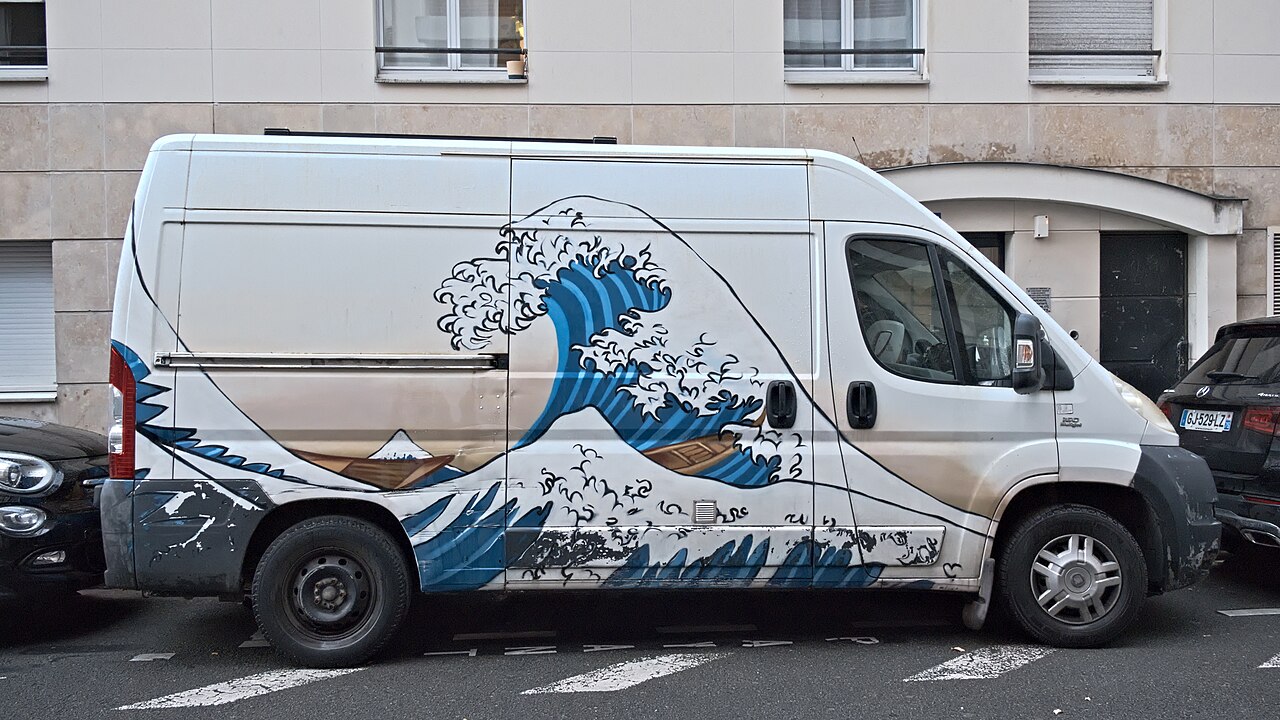
The Great Wave off Kanagawa 1831
Published around 1831 as part of the Thirty-Six Views of Mount Fuji series, The Great Wave off Kanagawa (Kanagawa-oki Nami-ura) is now the most reproduced image in the history of art. The composition is an act of controlled violence: a concave wall of dark ocean water rises to fill the upper two-thirds of the print, its foam-claws reaching inward like fingers. Three oshiokuri-bune (fast cargo boats) disappear beneath the claw, their oarsmen clinging to the hulls. In the lower right, barely three centimetres high, Mount Fuji sits inverted in form, its snow-capped peak mirroring the wave's foam. The pyramid of Fuji and the pyramid of the wave answer each other across the picture plane. Hokusai built the composition in Prussian blue — then newly imported from Europe — graduating the tone across the wave's interior from deep navy to pale aquamarine, with white left unprinted for the foam. The scale relationship between the monstrous wave and the distant, diminished mountain makes this the most radical spatial gamble in his career: the eternal landmark has been temporarily dwarfed by a single moment of the sea. The image entered European consciousness in the 1860s and supplied the dominant visual metaphor of the Art Nouveau movement.
Fine Wind, Clear Morning (Red Fuji) 1830
Known in Japanese as Gaifū Kaisei and in English as Red Fuji, this print from the Thirty-Six Views series is the other canonical Hokusai image, and in Japan is considered the more beloved of the two. The composition is austere where The Great Wave is violent: Fuji fills the picture from lower left to upper right, rendered in bands of colour that shift from crimson-orange at the peak to deep viridian forest at the lower slopes. A thin band of Prussian blue sky and a few brushstroke clouds occupy the top quarter. There are no human figures, no boats, no foreground incident — only the mountain and the light on it. The crimson colouration represents the mountain in early autumn, when the summer snow has melted and the bare rock catches the morning sun before the heat of the day bleaches it back to grey. Hokusai achieved the graduated sky by exploiting the bokashi technique — a brush of colour applied to the block itself, rather than to the paper, creating a tone that fades evenly across the surface. The result has a stillness and finality that the stormy drama of The Great Wave deliberately avoids. Together the two prints form the emotional poles of the series: catastrophe and serenity, the momentary and the eternal.
Dragon Flying over Mount Fuji 1849
Painted in ink and colour on paper in 1849 — the year of Hokusai's death, when he was eighty-eight years old — Dragon Flying over Mount Fuji stands apart from the woodblock prints that made his name as a work of intimate, almost visionary intensity. A great dragon, sinuous and scale-detailed, coils through turbulent clouds above the summit of Fuji, which rises in the lower portion of the composition as a small, stable pyramid beneath the creature's churning energy. In Japanese iconography the dragon is a bringer of rain and a symbol of celestial power; its association with Fuji carries overtones of the mountain's sacred volcanic nature. Hokusai had depicted dragons throughout his career — in the Manga, in surimono, in illustrated novels — but this late painting, produced in the final year of his life, has the quality of a testament. The brushwork is not the confident, controlled line of his middle decades but something freer and more charged: the clouds are suggested rather than described, the dragon's body moves with an urgency that younger hands could not easily have found. It is the last great image he made, and it shows a man still reaching.
Peonies and Butterfly 1834
Part of the Large Flowers series published around 1833–34, Peonies and Butterfly demonstrates the other register of Hokusai's achievement — the intimate, decorative, botanically precise study of the natural world at close range. Two large peonies dominate the composition, their pink petals rendered with layered colour printing of considerable technical sophistication: the gradation from deep rose at the petal tips to pale cream at the centre required multiple carefully registered blocks. A single butterfly — wings folded, antennae extended — rests at the lower left, providing scale and animation. Hokusai prints the leaves in a grey-green that anchors the warmth of the blossoms, and allows the white of the paper to serve as light on the petals themselves. The Large Flowers series is often discussed separately from the Thirty-Six Views, but it belongs to the same concentrated period of creative production in the early 1830s, and shares its preoccupation with the tension between flatness and volume, between the decorative surface and the illusion of space. Western botanists and collectors who encountered these prints in the Meiji period after Japan opened to trade frequently described them as more accurate than European botanical illustration — high praise for a man who would have called himself a draughtsman first.
Carp Swimming by Water Weeds 1831
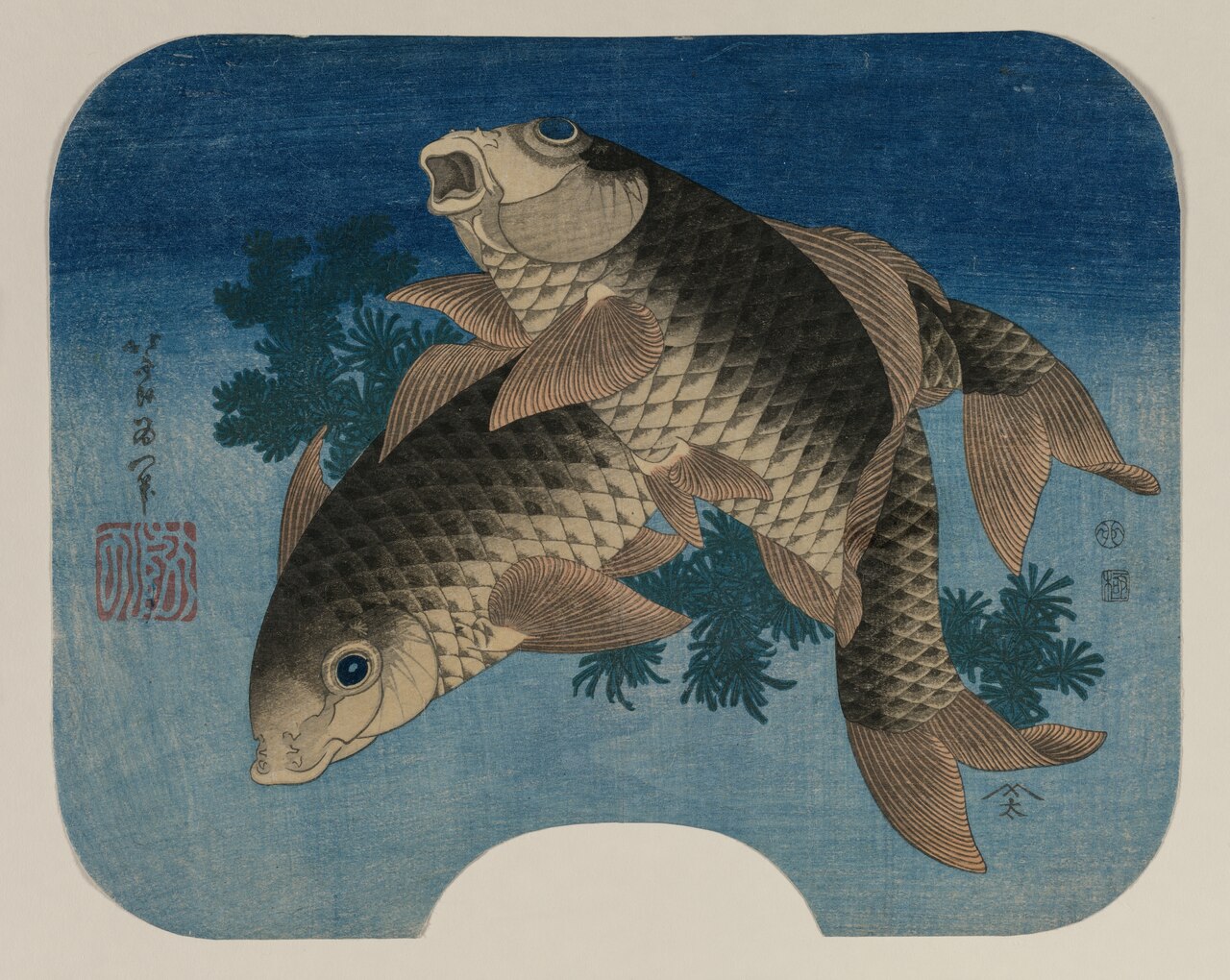
Also from the Large Flowers series or a related suite of natural-world studies published around 1831–34, Carp Swimming by Water Weeds places Hokusai in a tradition of Japanese and Chinese fish painting stretching back centuries — but the treatment is unmistakably his own. Two carp, one silver-grey and one golden-orange, move through dark water in opposite directions, their trajectories forming a slow, open spiral. Water weeds hang from the upper portion of the picture, their slender strands providing a vertical counterpoint to the horizontal drift of the fish. The carp's scales are suggested rather than enumerated — a few strokes of gradated colour establish the form without overcrowding the surface. Hokusai understood that in watercolour and woodblock alike, the unpainted area is as expressive as the mark: the dark water is simply the paper left unprinted, the fish's belly is the white of the sheet, and the light on the water comes from what is absent. In Japanese culture the carp carries associations of perseverance and longevity — it swims upstream, endures, outlasts — and it is difficult not to read into this late print something of the artist himself, still swimming through dark water at the age of seventy, still convinced the best work was ahead.