
Abstract Expressionism
Pollock dripped; Rothko glowed — America invented an art as large as its own ambition.
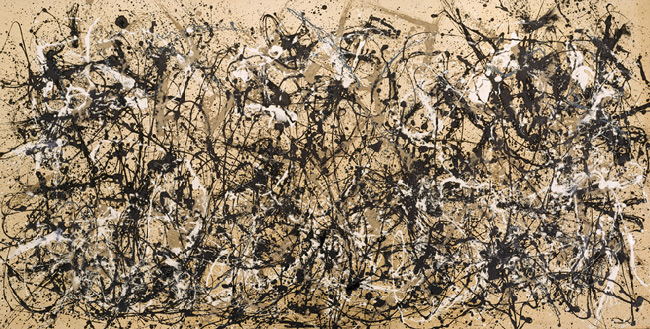
In the winter of 1947, Jackson Pollock moved a canvas from the wall to the floor of his barn studio in Springs, Long Island, picked up a hardened brush and a can of Duco house enamel, and began to pour. He walked around all four sides of the canvas, dripping and flicking paint in looping, overlapping skeins — no preliminary drawing, no gestural editing, no moment of stepping back and composing. The resulting work, which he titled *Full Fathom Five* and later *Number 1A*, looked like nothing that had been made before: dense, all-over, physically charged, impossible to read from any single vantage point. Abstract Expressionism was not born in a single moment — the term had been used for Kandinsky's early work — but Pollock's drip paintings of 1947–50 are its most radical declaration. The movement produced two distinct temperaments in a single generation of painters working in New York: the violent physical gesturalism of Pollock, de Kooning, Franz Kline and Lee Krasner, and the meditative chromatic fields of Mark Rothko, Barnett Newman and Clyfford Still. Both shared a commitment to painting as an act of absolute seriousness — nothing illustrative, nothing decorative, nothing less than a direct encounter with the condition of being alive.
Origin and history
Abstract Expressionism coalesced in New York in the early 1940s, but its ingredients had been accumulating for a decade. The crash of 1929 and the subsequent Depression had politicised a generation of American painters — many had worked on the Federal Art Project, painting post offices and public buildings, and several had moved through Social Realism and leftist politics. By the late 1930s that idealism had soured; Stalinism and the show trials had discredited Marxist utopianism, and the approaching European catastrophe made straightforwardly political painting feel inadequate to the moment.
The critical catalyst was the arrival of European avant-garde exiles after 1940. When Nazi Germany occupied Paris, a wave of Surrealists, Constructivists and theorists landed in New York: Max Ernst, Piet Mondrian, Fernand Léger, André Breton, Roberto Matta. Their presence transformed the city's art world. Younger American painters — Pollock, de Kooning, Arshile Gorky, Robert Motherwell — encountered Surrealist automatism directly, and the idea that unconscious impulse could generate valid pictorial form was exactly the permission they needed. Gorky's late paintings of the early 1940s, dense with biomorphic forms hovering in atmospheric space, are the clearest bridge between European Surrealism and the American movement that followed.
The movement crystallised around several New York institutions and figures. Peggy Guggenheim's gallery Art of This Century (opened 1942) showed the Europeans alongside young Americans. The Club, an informal gathering on Eighth Street from 1949 onward, provided a forum for debate — famously heated, frequently all-night — about the meaning and direction of abstract painting. The critic Harold Rosenberg coined the term Action Painting in his 1952 *ARTnews* essay, claiming that the canvas had become "an arena in which to act" rather than a space to represent anything. Simultaneously, the critic Clement Greenberg was constructing an influential alternative theory, arguing that the movement represented the logical evolution of Western painting toward pure optically — flatness, colour and surface as the only legitimate subject of a painting. The two critics were barely civil to each other, and their disagreement mapped exactly onto the division between the gestural and the Color Field painters.
Concept and philosophy
The defining question Abstract Expressionism asked — and refused to answer easily — was: what can a painting be about when it refuses to depict anything? The movement's painters arrived at different answers, but they shared a set of commitments that distinguish their work from everything that came before.
The first was the primacy of process. Where traditional painting treated the final surface as the work, and all evidence of making as something to be concealed under smooth finish, the Abstract Expressionists made the act of painting visible and often central. Pollock's drips record each pass of the hand; de Kooning's slashing strokes preserve the speed and pressure of the brush; Kline's black bands show the loaded brush dragged fast across raw white canvas. The painting is a record of its own making — a document of a physical and psychological event in real time.
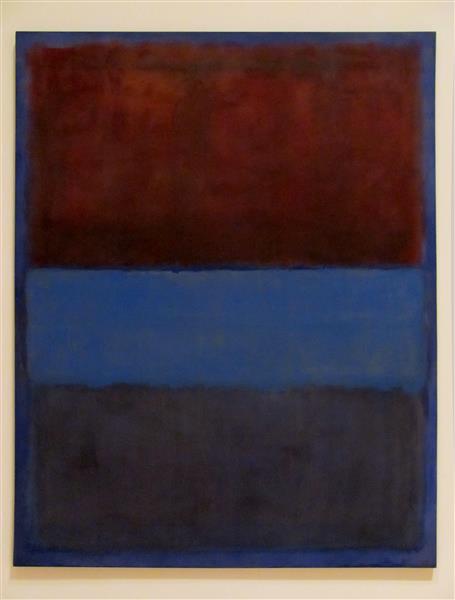
The second was scale as meaning. These painters worked large — often very large — as a deliberate choice about the kind of experience they wanted to produce. Rothko, who in his mature work painted hovering rectangles of colour on large canvases, specified that his works should be seen at close range, where they stop being pictures and start being environments. Newman's "zips" — thin vertical lines dividing vast flat colour fields — were designed to produce the experience of standing before something that cannot be taken in all at once. The viewer is not meant to step back and survey; they are meant to be inside the work.
The third commitment, particularly for the Color Field painters, was to colour as the primary bearer of emotion. Rothko believed — and empirical observation suggests he was right — that colour experienced at sufficient scale and saturation produces responses that bypass rational interpretation. The trembling dark reds and blacks of his late Seagram Murals (1958–59), now installed in the Tate Modern, are widely reported to provoke grief, dread and a sense of the sublime in viewers with no knowledge of art history. The painting communicates directly, through the nervous system.
Finally, the movement shared an ethical seriousness about painting as a high-stakes act. The scale of ambition was enormous — many of these painters explicitly invoked the tragic, the sublime and the mythological, seeing themselves not as producers of decorative objects but as practitioners of a morally serious enterprise. This seriousness, along with the scale and the refusal of representation, made the work initially bewildering to most audiences. It also made it, at its best, permanently inexhaustible.
How to recognise it
Six visual signatures that separate Abstract Expressionism from other abstract traditions — from Pollock's dripped skeins to Rothko's breathing colour and Newman's vertiginous verticals.
- Monumental, engulfing scale — Many canonical Abstract Expressionist works are very large — Pollock's *One: Number 31* (1950) runs to nearly 270 × 530 cm. The scale is not incidental; it is designed to prevent the viewer from standing outside the work and surveying it. If a painting seems to require you to move through or along it rather than step back from it, you are probably in this tradition.
- All-over composition — Pollock's drip paintings distribute activity uniformly across the entire surface with no compositional centre, no hierarchy of important and peripheral zones, no figure-ground relationship. The all-over field was a radical departure from every prior convention of pictorial organisation. If your eye has nowhere particular to land and nowhere to rest, it is all-over composition.
- Visible physical energy — Action Painting shows the physical event of its making: drips, splatters, raw canvas stained through, brush strokes dragged at speed, paint built into impasto ridges. De Kooning's *Woman* series shows paint applied, scraped off, and reapplied dozens of times — the resulting surface is a record of argument between painter and canvas.
- Soft-edged colour zones — In Color Field painting — Rothko, Newman, Still, Helen Frankenthaler — large areas of colour bloom or vibrate without hard edges. Rothko applied his paint in thin, layered washes that sink into the canvas rather than sitting on it, producing an atmospheric luminosity. Newman's "zips" create a precise vertical edge, but the colour fields on either side are vast and internally varied.
- Absolute non-representation — There are no recognisable objects, no figures, no landscapes, no symbols. The refusal of representation is absolute and principled — not a stylisation of something seen but a rejection of the premise that painting must depict. If the work contains anything resembling a recognisable form, it is probably not core Abstract Expressionism.
- Raw or stained canvas — Many Abstract Expressionist works use unprimed or lightly primed canvas, allowing paint to soak into the fabric rather than sitting on a gessoed surface. Frankenthaler's poured technique, Morris Louis's *Veils* — colour that has been absorbed into the canvas itself — produce a distinctly different quality of surface from paint that sits on top. If the colour seems to be *in* the canvas rather than on it, you are looking at stained abstraction.
Anecdotes and curiosities
Pollock's drip technique was partly learned from a Navajo sand painter. In 1941, Pollock attended a demonstration at the Museum of Modern Art by Navajo artists creating ceremonial sand paintings — standing over a horizontal surface and dropping dry pigment in precise patterns from above. The connection to his subsequent practice of working on a floor-level canvas, walking around all four sides and dripping enamel from a brush or stick, has been documented by biographers. Pollock was also in Jungian analysis at the time, and his therapist encouraged him to make automatic drawings as a clinical exercise. Both traditions — indigenous American and European Surrealist — fed what became the most influential painting technique of the twentieth century.
Mark Rothko refused to sell his Seagram Murals after seeing the restaurant. In 1958, architect Philip Johnson commissioned Rothko to paint a series of large works for the Four Seasons restaurant being built in the Seagram Building in New York — a project that Rothko accepted enthusiastically and into which he poured nearly two years of work. Then he had dinner at the restaurant. The room, he concluded, was being used for precisely the kind of ostentatious wealth-display he found morally contemptible, and he could not allow his paintings — which he wanted to produce "an experience of tragedy" — to hang in a space where the rich congratulated themselves over expensive food. He returned the commission and eventually donated the paintings to the Tate Gallery in London, where they have been since 1970.
De Kooning never stopped painting the figure, even inside abstraction. While Pollock and Newman argued for total abstraction, de Kooning insisted that the figure — specifically the female figure — was inescapable. His *Woman I* (1950–52), shown at the Sidney Janis Gallery in 1953, shocked critics who had assumed Abstract Expressionism had permanently abandoned figuration. De Kooning had worked on the painting for nearly two years, scraping and repainting it dozens of times, at one point abandoning it entirely before art historian Meyer Schapiro persuaded him to continue. The resulting image — a grinning, monumental, simultaneously aggressive and vulnerable woman — was read as everything from misogyny to homage, and remains one of the most contested paintings of the movement.
Lee Krasner's work was consistently overshadowed by Pollock's until after his death. Krasner, a trained painter who had studied under Hans Hofmann and was technically more grounded than Pollock when they met in 1941, became his partner and manager, frequently putting her own career aside to support his. After Pollock's death in a car crash in 1956, she inherited his estate, curated his legacy, and finally had the studio and the time to work at the scale she had always intended. Her *Umber* paintings of the late 1950s and *The Seasons* (1957) are among the most powerful works of the entire Abstract Expressionist generation — and they were made with the confidence of someone who had been watching and learning and waiting for nearly two decades.
Legacy and influence
Abstract Expressionism was the first moment in which the centre of gravity of Western art shifted definitively from Europe to the United States, and the movement's influence on subsequent art has been immeasurable. Its immediate heirs were the Color Field painters of the 1960s — Morris Louis, Kenneth Noland, Helen Frankenthaler — who extended Rothko's investigations into colour without gesture. Minimalism, paradoxically, grew partly as a reaction against Abstract Expressionism's emotional rhetoric, stripping painting back to the purely physical facts of surface, colour and support. Pop Art was a deliberate rebuke to AbEx's seriousness, replacing heroic abstraction with commercial imagery and irony. But the influence goes deeper than stylistic succession. The idea that a painting could be as large as a room and as serious as a philosophical argument — that scale and materiality could carry meaning without depicting anything — transformed what museums build and what collectors buy. The gesture of Pollock walking around his floor-level canvas, or Rothko specifying the lighting and hanging height of his works with contractual precision, established the artist as someone who controls not just the object but the conditions of its experience. Every installation artist working today is working in that expanded territory.
4 artists in this movement
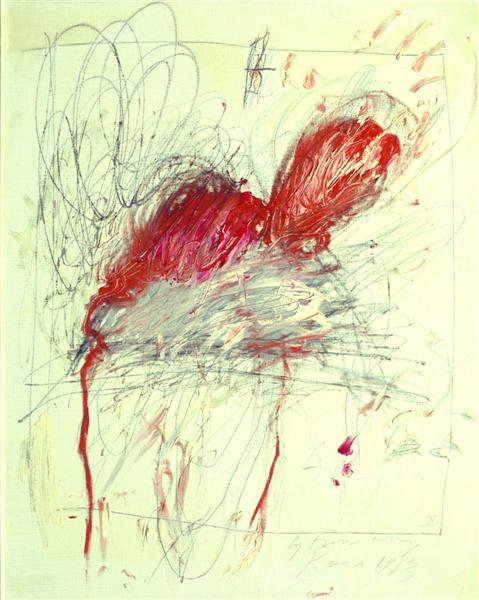
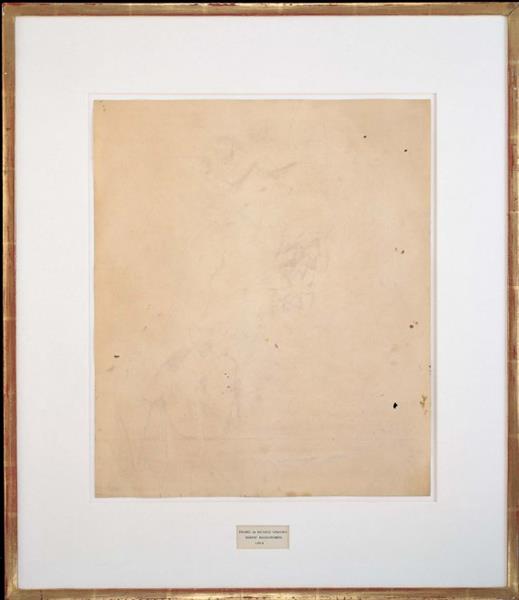
Frequently asked questions
What is the difference between Action Painting and Color Field painting?
Both are branches of Abstract Expressionism, but their visual character and theoretical emphasis differ sharply. Action Painting (Pollock, de Kooning, Kline, Krasner) foregrounds the physical act of making — drips, gestural strokes, impasto, the speed and pressure of the painter's body. Color Field painting (Rothko, Newman, Still, Frankenthaler) eliminates gesture in favour of large, soft-edged areas of colour designed to produce contemplative or overwhelming emotional experience. Critics Harold Rosenberg and Clement Greenberg championed each tendency respectively, and their disagreement shaped how the movement was understood for decades.
Why is Abstract Expressionism considered an American movement?
The movement emerged in New York in the 1940s among American-born painters (Pollock, Kline, Newman) and European émigrés who had settled in the US (de Kooning from the Netherlands, Rothko from Latvia). It was the first art movement to originate in the United States and achieve international dominance — a status amplified by the cultural politics of the Cold War, during which American institutions and the CIA covertly promoted abstract art as evidence of Western creative freedom in contrast to Soviet Socialist Realism. The movement's ambitions — large scale, philosophical seriousness, rejection of European traditions — were consciously American in character.
How did Pollock actually make his drip paintings?
Pollock laid unprimed canvas flat on the floor and worked from all four sides, never touching the surface with the brush. He used hardened brushes, sticks and syringes to drip, pour and fling liquid enamel and aluminium paint in continuous passes, building up layers of overlapping skeins. He described the process as a direct extension of his body: "I am in the painting." The technique drew consciously on Surrealist automatism and possibly on Navajo sand-painting traditions he had observed. The resulting surfaces appear chaotic close-up but reveal a consistent internal rhythm at distance — a structure that emerges from the body rather than the eye.
Who were the most important Abstract Expressionist painters?
The canonical Action Painters are Jackson Pollock (1912–56), Willem de Kooning (1904–97) and Franz Kline (1910–62); Lee Krasner (1908–84) is increasingly recognised as equally significant. The Color Field painters include Mark Rothko (1903–70), Barnett Newman (1905–70), Clyfford Still (1904–80) and Helen Frankenthaler (1928–2011). Arshile Gorky (1904–48) is generally treated as the crucial bridge figure between European Surrealism and the American movement. The sculptor David Smith and the painter Robert Motherwell complete the core generation.
What does 'all-over' composition mean?
All-over composition distributes pictorial activity uniformly across the entire canvas surface, with no dominant centre, no figure-ground hierarchy, no zones of importance or rest. Pollock's drip paintings are the purest example — the eye moves continuously across the surface without any single point anchoring it. The term was coined by critic Clement Greenberg to distinguish this radical departure from every prior convention of compositional organisation, which had always implied some kind of focal point or directional reading. All-over composition was one of Abstract Expressionism's most consequential formal innovations.