Edgar Degas
He never painted what his subjects were showing him — only what they didn't know they were doing.
Style and technique
Degas is called an Impressionist but was suspicious of the outdoors and refused to paint landscapes. His real subject was the human body in professional motion: the dancer at the barre, the jockey before the race, the café singer mid-phrase, the woman stepping out of a bath. He returned to these subjects for fifty years with a relentless, almost clinical curiosity.
The signature of his composition is the asymmetric cut. His figures are cropped by the edge of the canvas as if caught by a camera — a dancer's legs cut off at the thigh, a horse's head missing at the left, a woman's back dominating the right foreground while space opens unexpectedly at the left. He was among the first Western painters to study Japanese woodblock prints systematically, and their influence on his framing was decisive and immediate.
He was also one of the great draughtsmen of the nineteenth century. His technical training was classical — he studied under Louis Lamothe, a follower of Ingres, and worshipped Ingres himself, who he met once as a young man. Ingres told him to 'draw lines, young man, many lines'. He never stopped.
His materials changed as his eyesight failed in the 1880s. He moved increasingly to pastel, which could be applied in broader strokes and allowed him to rework the surface repeatedly without waiting for paint to dry. His late pastels — large-format, brilliantly coloured, the figures almost abstract in their energy — are among the boldest works of the period.
Four fingerprints: the asymmetric crop, the view from an unusual angle (above, from the side, from behind), the body in mid-movement captured at its least posed moment, and a cool, somewhat detached observation that refuses sentimentality.
Life and legacy
Degas was born on 19 July 1834 in Paris, the eldest son of a Parisian banker of Neapolitan origin and a Creole mother from New Orleans. The family was prosperous, cultured, and deeply interested in music. He studied law briefly — the family pattern — and then enrolled in the École des Beaux-Arts at twenty.
He spent three years in Italy between 1856 and 1859, studying the Renaissance masters in Florence and Rome. His Italian notebooks show him copying Mantegna, Raphael, and Ghirlandaio with great care. He returned to Paris with a classical grounding that he never entirely abandoned, even as his approach to contemporary subject matter became more radical.
He met Manet in 1862 while both were copying a Velázquez at the Louvre, and the friendship — spiky, competitive, mutually critical — lasted for decades and was central to both their careers. Manet pushed him towards contemporary urban subjects; Degas pushed Manet towards more careful drawing.
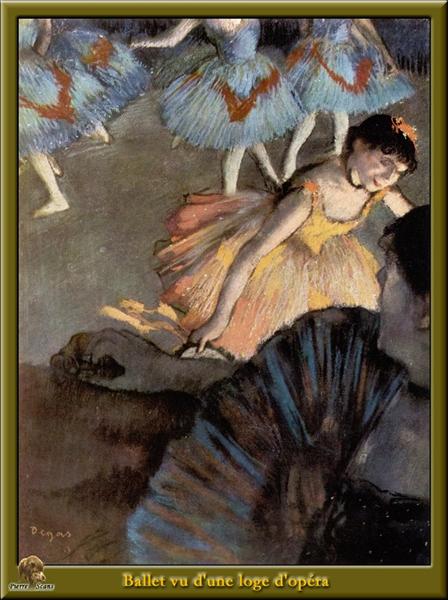
His access to the Paris Opéra Ballet came through a family connection to a subscriber in the 1870s. He attended rehearsals, was given access to the backstage areas, and produced over a thousand works — paintings, drawings, pastels, sculptures — related to the ballet over the next forty years. This access was unusual and carefully maintained. He understood the ballet not as glamour but as an institution with its own hierarchy, fatigue, and physical cost.
His eyesight began to fail in the mid-1870s, probably from a condition contracted during his service in the Franco-Prussian War of 1870. By the early 1890s he was nearly blind. He continued to work in pastel, modelling wax, and handling prints — techniques where the loss of fine detail was less catastrophic — until around 1908.
His personality was famously difficult. He was anti-Dreyfus during the affair of 1898, which cost him many friendships, including his long association with Pissarro. He was anti-social, caustic in his judgments, and lived alone from his forties onwards in increasing isolation. He died on 27 September 1917 in Paris, aged eighty-three. His studio contents — including the 150 wax sculptures that were posthumously cast in bronze — were auctioned over four days in 1918 and dispersed across the world.
Five famous paintings
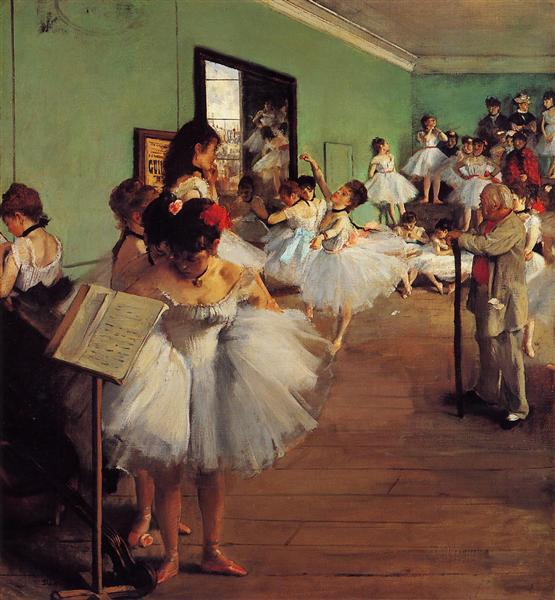
The Dance Class 1874
The ballet master Jules Perrot stands to the right of a studio room, resting on a staff, watching a girl at the centre perform. Around the room — seated on benches, adjusting ribbons, scratching backs, stretching at the barre — a dozen other dancers wait their turn with the specific inattentiveness of people waiting to be called. The composition is organised around empty space as much as figures: a large area of bare wooden floor occupies the centre. No one is performing for the viewer. Degas attended these rehearsals and painted what he actually saw: not the performance but its preparation. It hangs in the Musée d'Orsay.
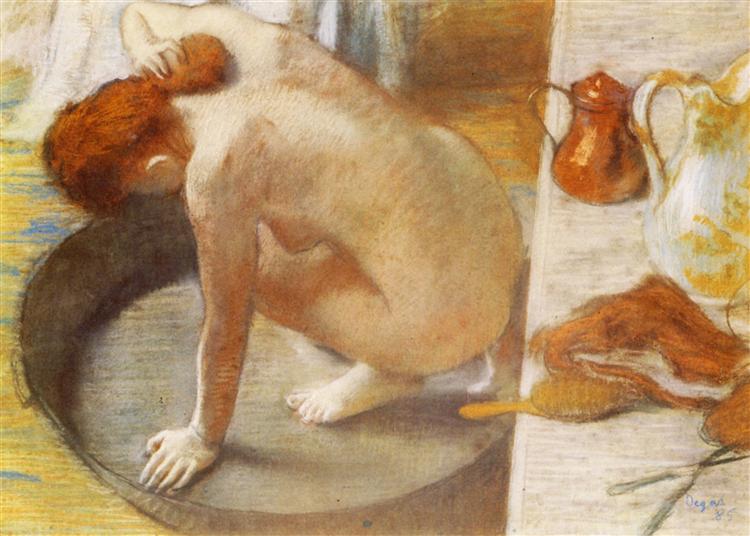
The Tub 1886
A woman crouches in a shallow metal tub, her back to the viewer, and sponges her neck. She is entirely absorbed in the act of washing — there is no awareness of being observed. The viewpoint is from above and slightly to one side, as if we have entered the room unexpectedly. The composition is one of Degas's most radically cropped: the tub cuts diagonally across the canvas and the woman's body, and a shelf of toiletry objects at the top provides a flat, almost decorative upper section. This pastel was shown at the final Impressionist exhibition of 1886 and described by critics as voyeuristic. It hangs in the Musée d'Orsay.
Pink Dancers 1885
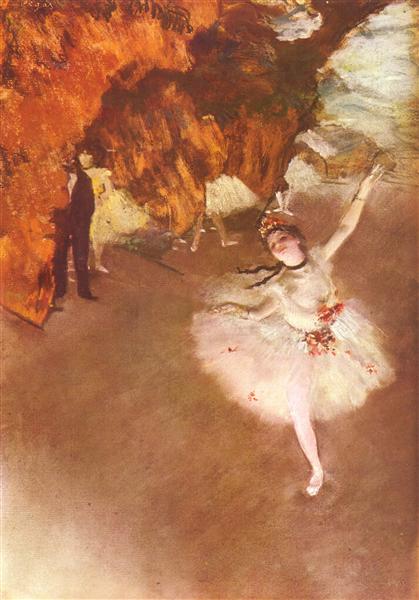
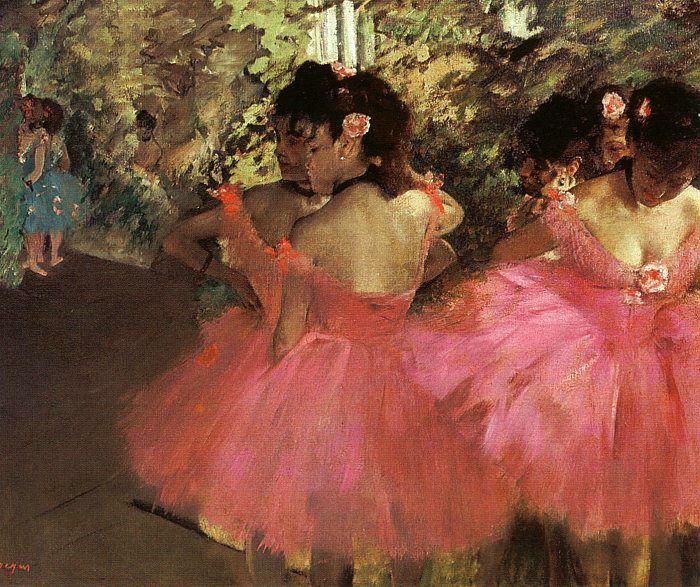
A group of dancers in pink tutus are photographed from an angle that shows several of them from behind or in three-quarter view, their arms raised or adjusting their costumes. The light is the warm artificial light of the stage or a studio. Degas used pastel for this work, the medium that increasingly suited his failing eyesight and allowed him to build up colour in layers and rework the surface. The pink of the tutus is built from multiple shades — rose, salmon, cream, pale orange — that vibrate against the blue-grey of the background. The cropping cuts two figures at the edge, as if a camera had caught the scene.
The Parade (Race Horses) 1868
Jockeys on horseback before a race — walking their horses in a loose group across a landscape of pale green turf under a high, bright sky. Degas's interest in horses was as sustained as his interest in dancers: they were both professional athletes operating within a strict institutional structure, and he was fascinated by the specific quality of their controlled movement. In this painting the jockeys and horses are arranged horizontally across the canvas in a shallow band, the composition borrowed directly from Japanese woodblock prints. Several horses and riders are cut by the frame at the left and right edges. It hangs in the Musée d'Orsay.
Interior (The Rape) 1869
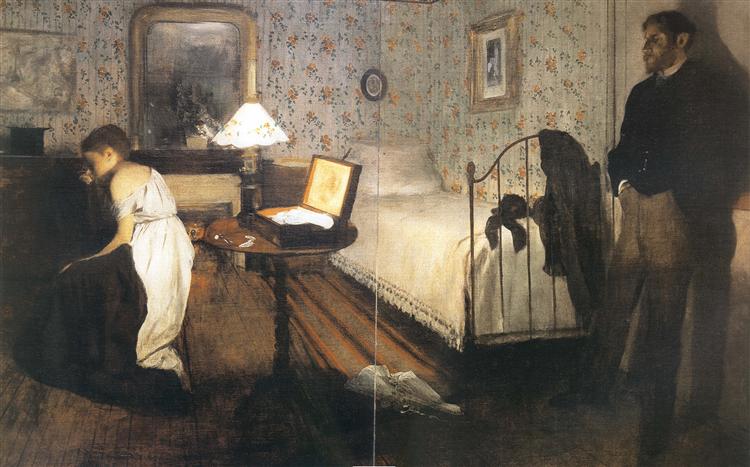
A dimly lit bedroom: a man stands near the door in the background; a woman sits slumped in a chair in the foreground, her shoulders bare. Between them, a lit lamp on a small table and a bed with rumpled sheets. The title 'The Rape' was given to the painting by later scholars rather than Degas himself, who called it simply 'Interior'. The subject has been identified with a scene from a Zola novel, but the painting is powerful precisely because of what it does not show. The two figures do not look at each other. Something has happened. The evidence is in the room. Degas never exhibited or sold the painting in his lifetime; it is now in the Philadelphia Museum of Art.