Berthe Morisot
She was Impressionism's most radical technician — the one whose marks went furthest from the thing they described.
Style and technique
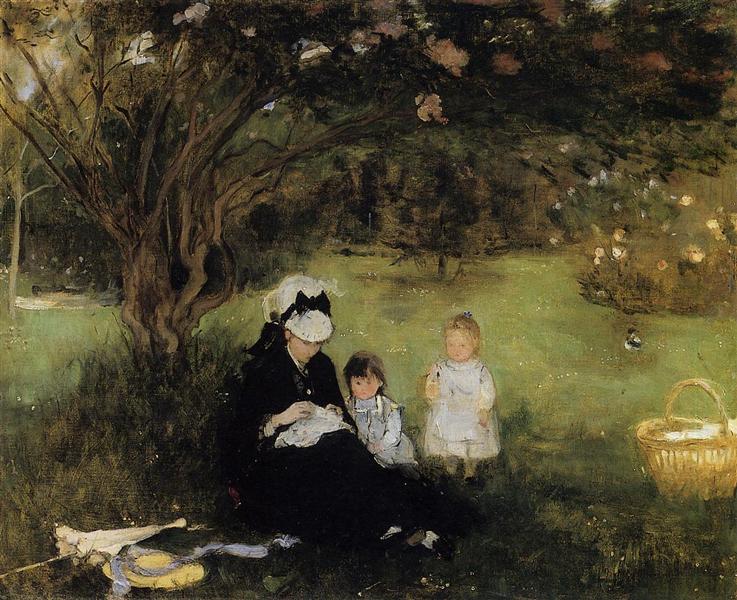
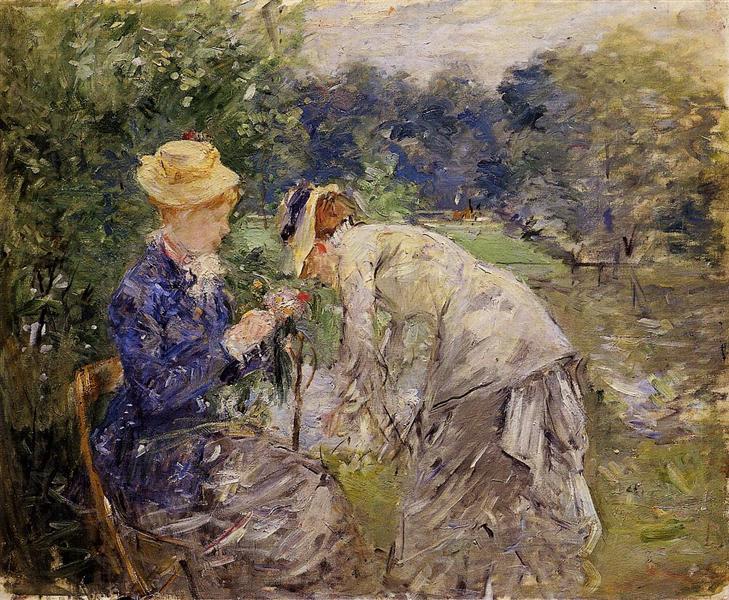
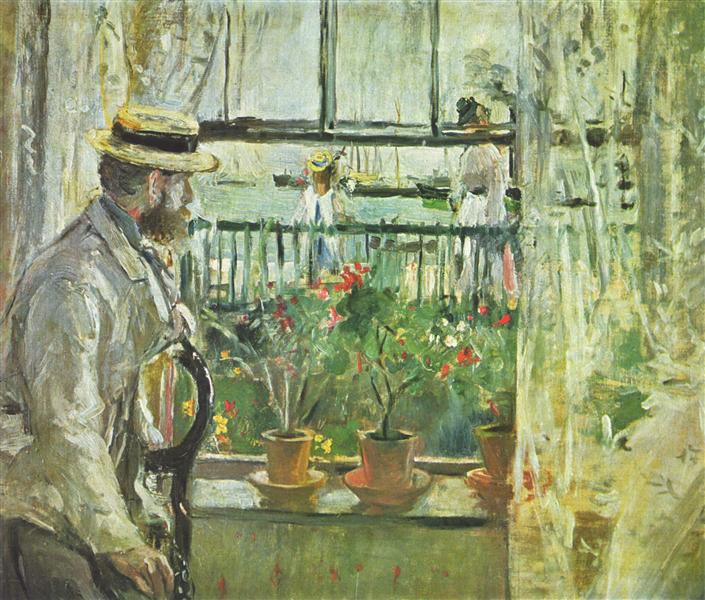
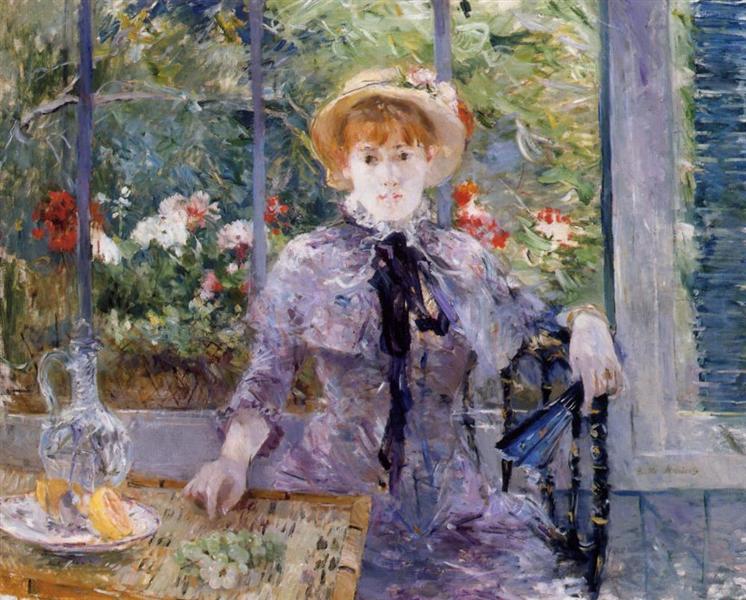
Of all the Impressionists, Morisot went furthest in the direction that the movement's logic pointed: toward paint that barely describes what it represents, that prioritises sensation over information, that lets the mark on the surface assert itself independently of the thing it depicts. Her brushwork in the mature paintings of the 1880s is among the most radical in nineteenth-century art — loose, nervous, energetic strokes that leave the canvas ground showing, that drag across each other without blending, that make figures and flowers and water dissolve at the edges into pure gesture.
Her subjects were drawn almost entirely from the world she inhabited: the domestic interior, the garden, the seaside, women with children, women at leisure — the social world that was available to a woman of her class and period. She did not paint cafés or racetracks or the urban working class; those subjects were not her world. What she painted instead was the particular quality of light and time in the spaces she knew, rendered with a formal invention that transforms the intimacy of the subject into something much larger.
She was close to Manet — he painted her several times and she married his brother Eugène — and the influence is visible in the confidence of her drawing and her willingness to let the composition resolve around areas of white and near-white. But where Manet remained committed to a certain solidity of form, Morisot increasingly dissolved form into light and air.
Four fingerprints: a loose, trailing brushstroke that barely fixes the form it describes, high-key palette of white, pale blue, and soft green that evokes the specific light of the Île-de-France and the Normandy coast, women and children in domestic and outdoor settings painted with complete unselfconsciousness, and a willingness to leave large areas of canvas barely touched that gives her paintings their characteristic airiness.
Life and legacy
Morisot was born on 14 January 1841 in Bourges, the daughter of a senior government official. The family moved to Paris in 1852, and both Berthe and her sister Edma showed early artistic gifts that were taken seriously — their parents hired professional painting teachers rather than merely encouraging a ladylike accomplishment.
Her first teacher of consequence was Camille Corot, whom she worked with in the early 1860s. From Corot she absorbed a way of working directly from nature, outdoors, with primary attention to tone and atmosphere rather than line. She and Edma worked together through the 1860s, both exhibiting at the Salon, until Edma married and withdrew from professional painting — a decision Berthe never made.
She met Édouard Manet in 1868, in the Louvre where she was copying Old Master paintings. The friendship was the most important professional relationship of her life. Manet painted her eleven times; she introduced him to the practice of painting en plein air (he had previously worked only in the studio); she gave him colour. The exchange was real and mutual, though art history — for a long time — credited only Manet's side of it.
She exhibited in the first Impressionist exhibition in 1874, the show that gave the movement its name, and in all but one of the subsequent Impressionist exhibitions — she missed the fourth in 1879 because of the birth of her daughter Julie. In 1874 she married Eugène Manet, Édouard's younger brother, and moved into the social world of the Manet family.
The 1880s were her most productive period. She worked in Normandy, in Bougival, in the Bois de Boulogne, producing the loose and luminous canvases on which her current reputation rests. She was supported by the critic Stéphane Mallarmé, who became a close friend, and by the collector and dealer Paul Durand-Ruel, who handled her work.
She died on 2 March 1895 in Paris, of pneumonia, aged fifty-four. Her daughter Julie Manet, who was fifteen at her death, became an important preserver of her memory.
Five famous paintings
Woman at Her Toilette 1875
A woman in white stands before a dressing table, partially reflected in a mirror, surrounded by flowers and brushes and the paraphernalia of the morning routine. The painting is characteristic Morisot in its dissolution of form into light: the figure is barely there, rendered in strokes of white, cream, and pale grey that merge with the dress and the table and the background into a single field of luminosity. The mirror adds depth — the reflection is barely distinguishable from the thing reflected. The domestic space is presented not as a scene but as an atmosphere, and the atmosphere is all light and morning air.
Summer's Day 1879
Two women in a rowing boat on a lake, the water behind them painted in loose horizontal strokes of blue, grey, and white that convey the specific light of water without describing it literally. One woman looks forward, one sideways; both are rendered in her characteristic late style — the faces resolved from strokes of paint rather than drawn in line. The reflections of ducks in the water to the right are among the most dissolving passages in her work. The painting was shown at the fourth Impressionist exhibition in 1880. It is in the National Gallery in London.