
Symbolism / Art Nouveau
Where Impressionism looked outward at light, Symbolism plunged inward into dream, myth and the terror of desire.
In 1886 the French poet Jean Moréas published a manifesto in *Le Figaro* declaring that art should not describe the visible world but evoke the invisible one — states of feeling, metaphysical intuitions, the half-glimpsed contents of dreams. Painting had been moving in exactly this direction for a decade. Gustave Moreau, in his Paris studio, was producing hallucinatory canvases of Salomé and Orpheus that looked like nothing so much as jewelled fever-dreams — every surface crusted with ornament, every figure simultaneously erotic and fatal. Odilon Redon was making lithographs of floating eyeballs, one-eyed monsters, flowers with human faces. The Belgian Fernand Khnopff was painting interiors of such uncanny stillness that they seemed suspended outside time. These painters were reaching for something that the Symbolist movement, loose and international, named but could not quite contain. In parallel, across Europe's applied arts, a sinuous organic line was sweeping through posters, furniture, book illustration and architecture — Art Nouveau in France, *Jugendstil* in Germany, *Modernisme* in Catalonia — fed by Japanese *ukiyo-e* woodblocks, by Pre-Raphaelite medievalism, by the conviction that beauty could be functional and ornament could be meaningful. Gustav Klimt stood at the intersection of both impulses, his canvases encrusting Symbolist allegory in gold-leaf surfaces of almost architectural flatness.
Origin and history
The Symbolist tendency in painting grew from several converging streams in the 1860s and 1870s. The English Pre-Raphaelites — Rossetti, Burne-Jones, Millais in his later work — had already proposed that painting should aspire to a kind of intense, archaic beauty derived from medieval and early Renaissance sources, and that women could function as archetypal symbols — the femme fatale, the angel, the muse — rather than as portrait subjects. Their work was enormously influential in France and Belgium.
In Paris, Gustave Moreau (1826–98) was painting mythological subjects with a peculiar, encrusted intensity: *Oedipus and the Sphinx* (1864) at the Salon, *Salomé Dancing Before Herod* (1876), vast, jewel-laden, simultaneously sensual and ascetic. He taught at the École des Beaux-Arts from 1892, and his students included Matisse and Rouault — both of whom later described the experience of his studio, crammed with half-finished mythological canvases, as transformative. Puvis de Chavannes offered a quieter, more classical variant: mural-scale decorations of idealised pastoral worlds in pale, chalky fresco-like tones that influenced Seurat and later Picasso's Blue Period.
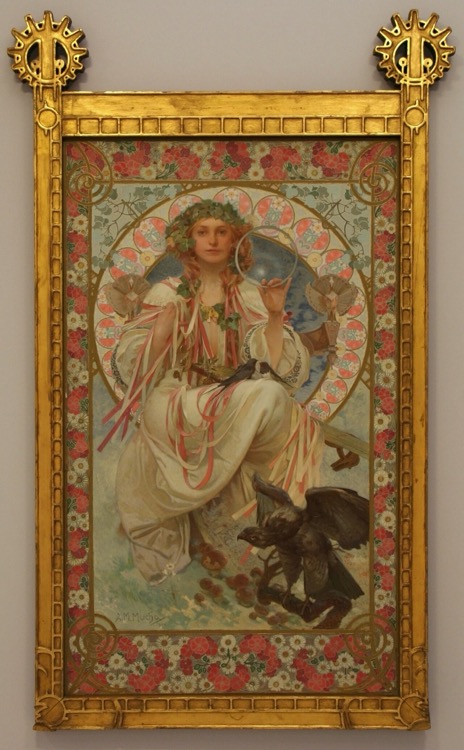
Art Nouveau emerged from a different source: the design reform movement and the rediscovery of Japanese decorative art after Japan's forced opening to the West in the 1850s. The *ukiyo-e* woodblock print — with its flat colour, strong outline, asymmetric composition and celebration of organic, curving form — was a revelation to European designers who had grown up with the rectilinear grammar of the classical tradition. In England, Arthur Mackmurdo designed his famous sinuous title page for *Wren's City Churches* in 1883, and Aubrey Beardsley developed the whiplash line into a graphic style of extraordinary perversity and elegance. In Paris, Alphonse Mucha's posters for the actress Sarah Bernhardt (from 1894) made Art Nouveau a commercial phenomenon — sinuous figures enclosed in Byzantine halos of ornament, printed on the street corners of every major European city.
Concept and philosophy
Symbolism in painting rested on a fundamental conviction about the hierarchy of subject matter: the visible world was less interesting than the invisible one. For the Realists, painting should record material social reality; for the Impressionists, it should record perceptual sensation; for the Symbolists, it should evoke psychological and metaphysical states that lay beneath or behind visible reality. This required a shift from description to suggestion — from the canvas as a window onto the world to the canvas as a resonating surface.
The Symbolist painters developed several strategies for achieving this. Moreau overloaded his canvases with symbolic ornament: every detail of costume, setting and gesture carried iconographic weight, like a text written in images. Redon worked through hallucinatory juxtaposition: a floating eyeball, a spider with a human face, a flower that was also a skull — images assembled by the logic of dreams rather than the logic of narrative. Khnopff used uncanny stillness and spatial ambiguity: rooms in which the light falls wrongly, figures who seem to be listening to something inaudible, spaces that feel both interior and infinite.
Art Nouveau shared Symbolism's rejection of academic convention but pursued a different programme: the elimination of the boundary between fine art and decorative art. For Klimt, Mucha and Beardsley, a painting and a poster were morally and aesthetically equivalent; the frame of a canvas and the cover of a book were equally valid vehicles for visual imagination. This was a profoundly democratic aesthetic — or at least a commercially ambitious one — that the nineteenth-century Academy, which strictly ranked painting above all other visual arts, found scandalous.
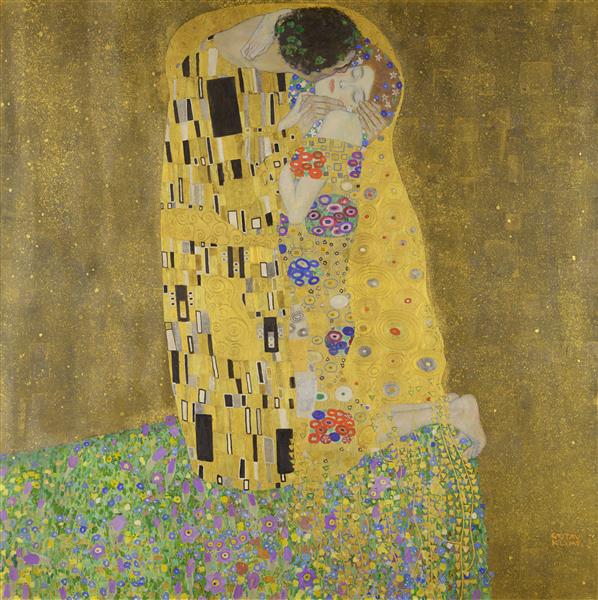
Klimt is the painter who most completely fuses the two tendencies. His gold-leaf canvases — *The Kiss* (1907–08), *Judith I* (1901), *Portrait of Adele Bloch-Bauer I* (1907) — are simultaneously Symbolist allegories of desire and death and Art Nouveau decorative objects of extraordinary refinement. The figures are painted with high psychological realism; the surrounding surfaces are dissolved into fields of Byzantine gold and ornamental pattern. The result is a style that is unique, unmistakable and impossible to categorise neatly.
How to recognise it
Symbolism and Art Nouveau share an aesthetic family resemblance even when their specific techniques differ — here are the six features that most reliably identify them.
- Sinuous, organic line — The whiplash curve — a long, flowing, asymmetric line derived from plant forms, water and hair — runs through Art Nouveau in every medium. In painting, it appears as flowing drapery, cascading hair that merges with ornamental pattern, and contours that undulate rather than define. This *ligne arabesque* is the movement's most immediate visual signature.
- Gold, ornament and flat decorative areas — Klimt's work is the extreme case: gold leaf applied directly to canvas, surrounding realistic figure-painting with areas of pure flat pattern — spirals, eyes, geometric forms — that read as decoration rather than space. Even in painters who do not use gold, Symbolist canvases tend toward rich jewel-toned surfaces in which ornament competes with narrative.
- Dreamlike or mythological subject matter — Sphinxes, mermaids, Salomé, Medusa, the femme fatale, personified Death — mythological and allegorical figures drawn from multiple cultural traditions (Greek, biblical, Celtic, Egyptian) treated as bearers of psychological rather than narrative meaning. The subject is always a state of feeling: desire, dread, ecstasy, melancholy.
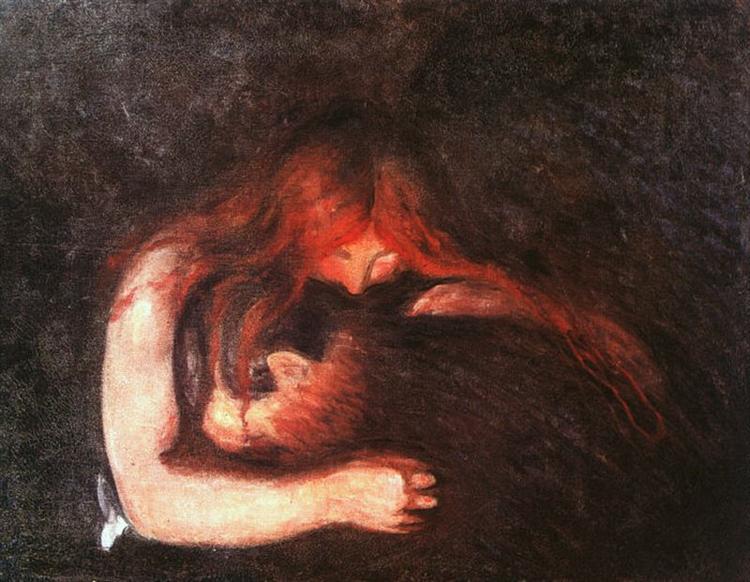
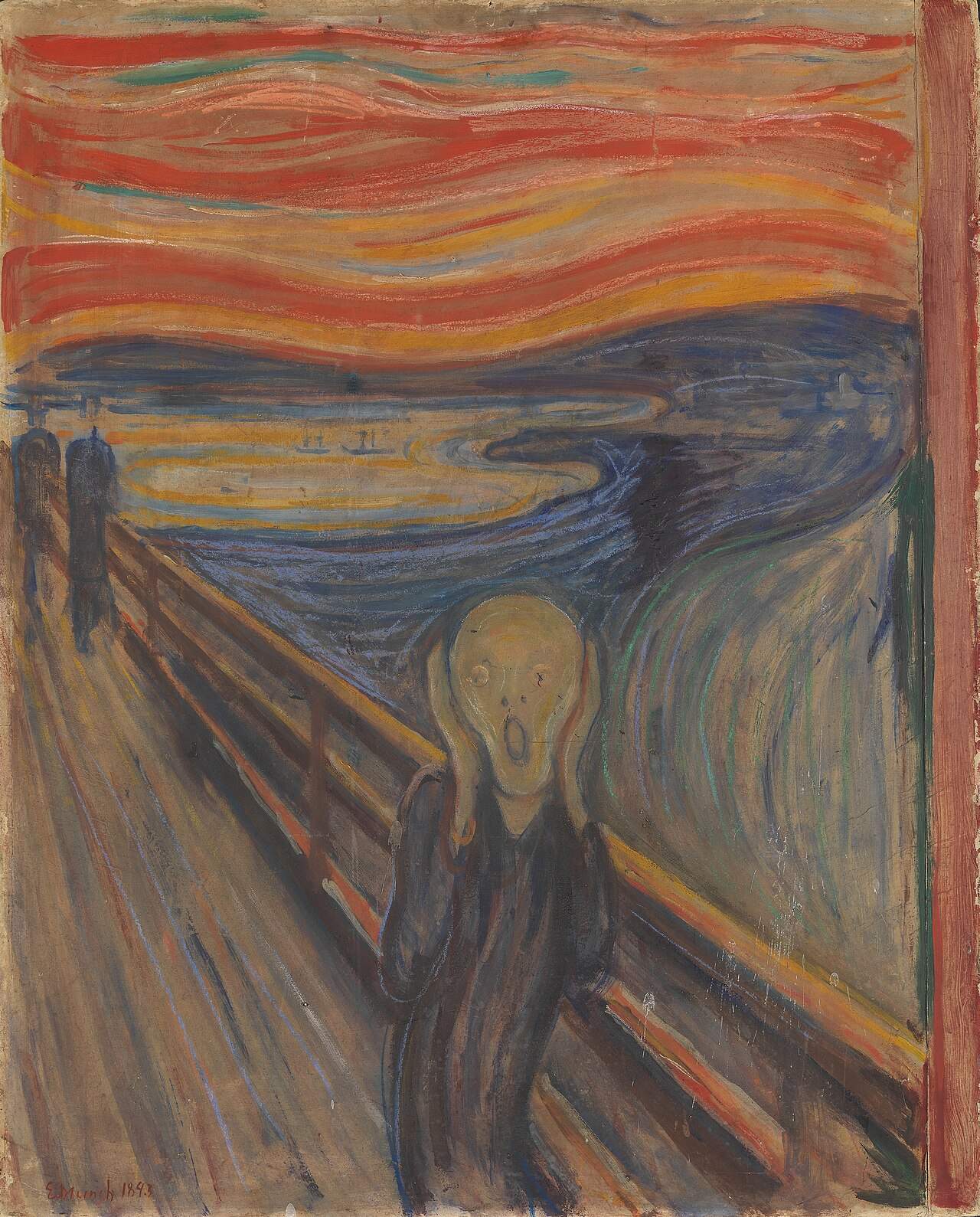
- Rich, jewel-toned or melancholy palette — Two quite different colour ranges coexist in the movement: the deep purples, golds and crimsons of the southern Symbolists (Moreau, Klimt, Mucha) and the silvery, desaturated greys and muted blues of the northern variant (Khnopff, Munch in his Symbolist phase, Spilliaert). Both are deliberately anti-naturalistic — colour chosen for atmosphere, not description.
- Female figures as archetypes — Women in Symbolist painting are rarely individuals — they are archetypes: the eternal feminine, the destroyer, the muse, the sphinx. Long hair, elongated forms and a quality of intense, inward expression recur across the movement from Rossetti's models in London to Mucha's poster heroines in Prague. This archetypal treatment is one of the movement's most discussed — and most criticised — characteristics.
- Surface texture as meaning — In Art Nouveau painting and graphic art, the surface itself is the subject: the way a line curves, the texture of ornament, the relationship between a figure and the decorative field that surrounds her. Where academic painting subordinates surface to illusion, Symbolist/Art Nouveau work draws equal attention to both. If the decorative surface design seems as important as the narrative content, you are almost certainly in this territory.
Anecdotes and curiosities
Moreau left his studio exactly as he died in it. Gustave Moreau had no children and was unmarried; his entire estate — thousands of paintings, drawings and watercolours, along with his Paris house on the Rue de la Rochefoucauld — he left to the French state with the specific instruction that it be maintained as a museum. The Musée Gustave Moreau, which opened in 1903, contains over fourteen thousand works, including six thousand drawings displayed in rotating drawers that visitors can pull open and inspect at will. It remains one of the strangest and most intimate artist's museums in Europe.
Mucha's most famous posters were made by accident. In January 1894, the actress Sarah Bernhardt needed a new poster for her production of *Gismonda* at the Théâtre de la Renaissance — urgently, while her usual designer was on holiday. The print shop where Alphonse Mucha was working on a calendar was given the commission. Mucha designed a tall, narrow poster overnight: Bernhardt in Byzantine robes, enclosed in a semicircular arch of ornament, her name in curling letters below. Bernhardt was so delighted that she signed Mucha to a six-year exclusive contract. He became the most famous poster artist in Europe without having intended to be a poster artist at all.
**Klimt's *Philosophy* caused a Viennese scandal. In 1894 the Austrian Ministry of Education commissioned Klimt to paint three ceiling panels for the ceremonial hall of the University of Vienna — allegorical representations of Philosophy, Medicine and Jurisprudence. When the finished canvases were exhibited at the Secession in 1900, eighty-seven professors at the university signed a formal protest: the figures were nude, the allegories were pessimistic**, and Medicine showed a column of naked human bodies drifting helplessly rather than the triumph of science. The Ministry eventually refused the paintings; Klimt kept them himself. All three were destroyed by SS troops retreating from Schloss Immendorf in 1945.
Redon gave flowers human souls. Odilon Redon spent the first part of his career producing exclusively black-and-white lithographs — obsessive, disturbing, beautiful — of eyes, monsters and imaginary botany. After the death of his infant son in 1886 and the birth of a surviving child in 1889, he began working in colour for the first time, producing the luminous pastel and oil flower studies for which he is now perhaps best known. He described the shift as a kind of psychological liberation: "I felt the need of colour as a friend." His late flower pastels — intensely coloured, quasi-abstract — influenced the Nabis and, through them, the entire decorative art of the early twentieth century.
Legacy and influence
Symbolism's direct heirs were Expressionism and Surrealism: both took its insistence on psychological states over observable reality and pushed it further, toward distortion (Munch's line runs from Symbolism to Expressionism without a gap) and toward the systematic exploration of the unconscious (Moreau, Redon and the Symbolist dreamworld are everywhere in early Dali and de Chirico). Art Nouveau's legacy runs through the Wiener Werkstätte, the Bauhaus (which rejected its ornamentalism but absorbed its conviction that design and fine art were equal) and ultimately into the graphic design of the twentieth century — the Art Nouveau poster is the direct ancestor of the advertising poster, the album cover, the branded logotype. Klimt's gold-leaf surfaces influenced every luxury visual culture that followed, from Hollywood cinema to contemporary fashion photography. And Mucha, who spent his final years creating the colossal *Slav Epic* cycle (1910–28) for the Czech national collection, stands as the strange proof that an artist who began by designing theatre posters could end by attempting the largest nationalist visual statement of the early twentieth century.
4 artists in this movement
From the blog
Frequently asked questions
When did Symbolism and Art Nouveau flourish?
Symbolism in painting is conventionally dated from the mid-1860s (Moreau's first Salon submissions, Redon's earliest work) to around 1910, though Redon continued until 1916 and Khnopff until 1921. Art Nouveau as a coherent style flourished most intensely between 1890 and 1910: Mucha's Bernhardt posters begin in 1894, Klimt's gold-leaf phase from about 1900, the style's commercial peak around 1900. By 1910 it was being replaced by the geometric severity of early Modernism, though it never entirely disappeared.
Who are the key painters of Symbolism and Art Nouveau?
Symbolism: Gustave Moreau (1826–98), visionary mythologist; Odilon Redon (1840–1916), master of the hallucinatory print and pastel; Fernand Khnopff (1858–1921), the Belgian of uncanny interiors; Puvis de Chavannes (1824–98), mural idealist; and Edvard Munch (1863–1944) in his Symbolist phase. Art Nouveau: Gustav Klimt (1862–1918), painter of gold and desire; Alphonse Mucha (1860–1939), the commercial face of the movement; Aubrey Beardsley (1872–98), its most perverse graphic genius; and Franz von Stuck (1863–1928), the Munich mythologist.
What technique defines Symbolism?
Symbolism has no single technique — it is defined by subject matter and intent rather than method. What unites Symbolist painters is the use of visual suggestion over description: ambiguous spaces, archetypal figures, symbolic objects chosen for psychological resonance rather than narrative function. Art Nouveau, by contrast, does have a defining technique: the sinuous organic line (*ligne arabesque*) derived from plant forms, combined with flat decorative areas that collapse the distinction between figure and ornament. Klimt's gold-leaf *cloisonné* effect is the most extreme case.
How does Symbolism differ from Impressionism?
The difference is fundamental. Impressionism turned painting outward — toward the visible, material, sensory world, observed with scientific attention to light and colour at a specific moment. Symbolism turned painting inward — toward psychological states, dreams, myth and metaphysical intuition that lie beyond or beneath visible reality. Where an Impressionist painting records what the eye sees, a Symbolist painting evokes what the mind imagines or fears. Colour, line and subject are all chosen for psychological atmosphere rather than perceptual accuracy.
Why are Symbolism and Art Nouveau grouped together?
They are grouped here because they shared a generation, an aesthetic and a reaction: both emerged in the 1880s–1890s as revolts against Realist and academic painting, both rejected the mimetic tradition in favour of psychological or decorative values, and both were deeply influenced by Japanese art and the Pre-Raphaelites. Klimt is the painter who most completely fuses them — his canvases are simultaneously Symbolist allegories and Art Nouveau decorative objects. In practice the two tendencies often overlapped in the same artists and exhibitions, particularly in Belgium, Austria and Catalonia.