
Neo-Impressionism
Seurat turned Impressionism into a science and painted stillness with a million tiny suns.
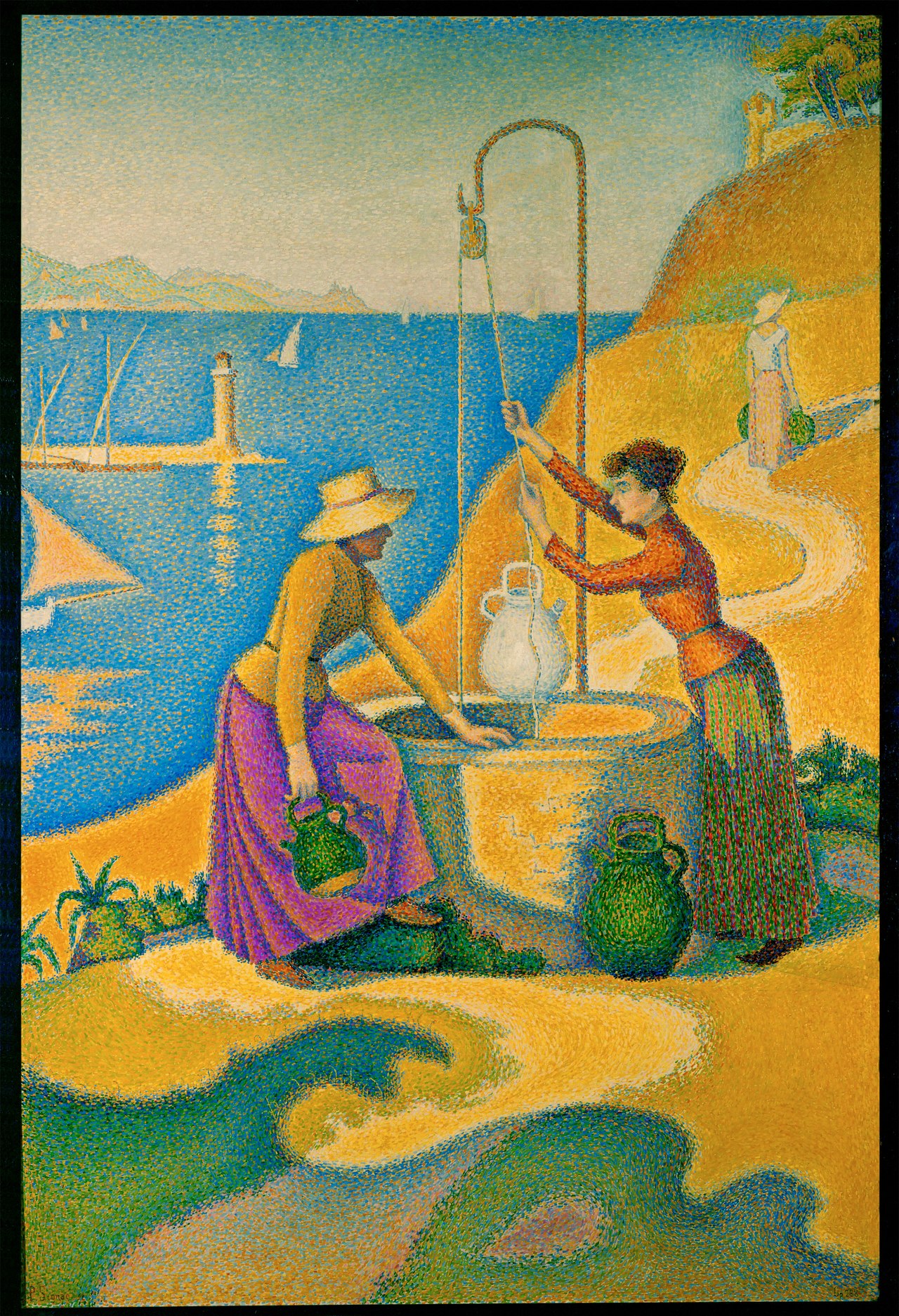
In the spring of 1884, a twenty-four-year-old painter named Georges Seurat began a canvas unlike anything that had been attempted before. *A Sunday on La Grande Jatte — 1884* was nearly two metres high and over three metres wide, and it depicted a leisure scene on a Seine island near Paris — Parisians strolling, children running, dogs on leads, a monkey on a leash — rendered entirely in tiny, discrete dots of unmixed pigment. Seurat had spent two years preparing it: more than fifty oil sketches, dozens of Conté crayon drawings, systematic study of the colour theorists Ogden Rood and Eugène Chevreul. When the painting appeared at the eighth and final Impressionist exhibition in May 1886, alongside works by the converted Pissarro and the enthusiastic Signac, it announced a programme rather than a painting: Neo-Impressionism, the attempt to replace Impressionism's intuitive spontaneity with a systematic, scientific method. The technique, called Pointillism by critics and *Divisionism* by the painters themselves, was grounded in the theory that small dots of pure colour placed side by side would mix *optically* in the viewer's eye — producing more luminous results than the physical mixing of pigments on a palette ever could. Whether the science entirely held up is disputed; that the paintings were unlike anything seen before is not.
Origin and history
The intellectual foundations of Neo-Impressionism were laid not in a painter's studio but in the laboratories and lecture halls of nineteenth-century colour science. Eugène Chevreul, the chemist who directed the Gobelins tapestry works in Paris, published his law of *simultaneous contrast* in 1839: adjacent colours influence each other, so that a grey placed next to orange looks slightly blue, and a grey next to blue looks slightly orange. Ogden Rood, the American physicist, published *Modern Chromatics* in 1879, distinguishing between the mixture of coloured light (additive, where red + green = yellow) and the mixture of pigments (subtractive, where red + green = brownish-grey) and arguing that optical mixture of small patches of colour approached the luminosity of additive colour mixture.
Seurat read both and drew a conclusion that was partly correct and enormously productive: if you place small dots of red and yellow side by side rather than mixing them on the palette, the eye will mix them optically into a more luminous orange than any tube of paint could produce. The technique he developed — applying colour in small, regular, comma-shaped or circular dots across the entire canvas — was laborious beyond anything the Impressionists had imagined. *La Grande Jatte* required two years of preparatory work and was described by Seurat's friend Félix Fénéon, who coined the term 'Neo-Impressionism' in a review published in September 1886, as an act of "patient tapestry-weaving."
The movement spread quickly to Paul Signac, who became its most energetic propagandist and eventually its theorist, publishing *From Eugène Delacroix to Neo-Impressionism* in 1899. It spread to the Belgian group Les XX, which included Théo van Rysselberghe, and briefly captivated the elder Camille Pissarro, who adopted the technique from 1885 to 1890 before concluding that it was "monotonous" and returning to his earlier manner. Seurat himself died suddenly in 1891, aged thirty-one, of what was probably bacterial meningitis — one of the most consequential early deaths in the history of art.
Concept and philosophy
Neo-Impressionism was built on a paradox: the attempt to systematise spontaneity. Impressionism had celebrated the immediate, intuitive response of the painter's eye — the brushstroke that records a fleeting sensation before habit has time to intervene. Neo-Impressionism took the Impressionist discoveries about colour (broken colour, coloured shadows, the primacy of light) and submitted them to rational method: every colour relationship calculated, every dot deliberate, every brushstroke identical in size and consistent in direction. The result was paintings of unusual luminosity and, paradoxically, extraordinary stillness.
The stillness was not accidental. Because the pointillist method required sustained concentration and methodical application, it made spontaneous recording of movement essentially impossible. The figures in *La Grande Jatte* are not caught in motion; they are frozen, like figurines in a diorama. The light does not flicker; it hums. Critics of the time noted — sometimes admiringly, sometimes sarcastically — that the painting had the quality of an Egyptian frieze: formal, eternal, slightly monumental. Seurat was not embarrassed by this; he thought that the combination of scientific colour and geometric order would produce a new kind of painting that transcended both the anecdotal and the merely decorative.
Signac's version of the technique was looser and more energetic than Seurat's — his dots grew larger, more like mosaic tesserae, and his palettes became more brilliantly chromatic as he aged, moving from Mediterranean harbours to the blazing landscapes of the Midi. His influence on the Fauves was decisive: Matisse spent the summer of 1904 painting with Signac at Saint-Tropez and, while he abandoned the dot, took away a permanent conviction that colour could be used at maximum intensity without reference to natural appearance.
The long-term legacy of Neo-Impressionism was less about the dot itself than about colour theory as a conscious tool: the idea that a painter could and should think systematically about colour relationships — complementaries, contrasts, simultaneous effects — rather than relying on intuition alone. That idea passed through the Bauhaus, through Josef Albers's *Homage to the Square* series, and ultimately into the digital colour systems that govern screen displays and printed images today.
How to recognise it
Neo-Impressionist paintings have one of the most immediately recognisable surfaces in Western art — once you know what you are looking at, the dots are unmistakable.
- The systematic dot — Small, regular, carefully placed touches of pure, unmixed pigment cover the entire canvas surface. Stand close and you see a mosaic of individual colour; step back and the dots optically blend into coherent form. The dot is the movement's signature and its most immediately recognisable feature.
- Divided, complementary colour — Shadows contain their complementary colours (a red shadow contains green; an orange shadow contains blue), and each colour area is systematically edged with its complement to increase vibratory contrast. The simultaneous contrast effect means colours appear more saturated than they would in isolation.
- Unusual luminosity — The overall effect of optical colour mixture is a canvas that seems to glow from within rather than merely reflect light. Surfaces shimmer in a way that physically mixed paint cannot quite replicate. This luminous quality is particularly striking in Seurat's harbour and river scenes.
- Geometric, frozen composition — Because the method required sustained application rather than rapid notation, Neo-Impressionist compositions tend to be static and monumental: figures are posed rather than caught in motion, compositions are carefully planned, and the sense of immediate, fleeting sensation that characterises Impressionism is absent.
- Leisure and landscape subjects — Beaches, parks, riverbanks, Mediterranean harbours — the same leisure world as Impressionism, but rendered with an entirely different sense of time. Seurat's figures feel eternal; Signac's landscapes feel like distillations rather than observations.
- Seurat vs Signac distinctions — Seurat's dots are smaller, more regular, his palettes cooler and his compositions more monumental and still. Signac's dots are larger and more mosaic-like, his colours more brilliant, his compositions more energetic and decorative. If the painting vibrates with Mediterranean colour, it is more likely Signac; if it has the quality of a carved relief, more likely Seurat.
Anecdotes and curiosities
Seurat guarded his technique jealously. When Signac began enthusiastically spreading the pointillist method to other painters, Seurat grew increasingly possessive of what he saw as *his* invention. He wrote private letters complaining that others were diluting the system, and he continued to refine his theories about colour and linear expression — believing that diagonal lines going upward expressed joy, downward lines sadness, and horizontal lines calm — right up to his death. His final major canvas, *The Circus* (1890–91), was still unfinished on the studio easel when he died in March 1891.
Pissarro adopted and then abandoned the dot. The eldest of the original Impressionists, Camille Pissarro was so impressed by *La Grande Jatte* when he saw it in 1886 that he converted to pointillism entirely, showing Neo-Impressionist works at the final group exhibition. He spent four years applying the method to his Norman village scenes and market squares — works technically accomplished but, he eventually concluded, unable to convey the spontaneous life he cared about. By 1890 he had returned to his earlier manner, writing to his son Lucien that the technique "inhibits me and prevents me from making the impulsive mark that counts."
Van Gogh experimented with the dot — briefly. During his eighteen months in Paris (1886–88), van Gogh was exposed to Seurat and Signac and spent several months applying a version of pointillism to his canvases. Works like *Self-Portrait* (1887, Stedelijk Museum) and *The Restaurant de la Sirène* (1887) show clear pointillist influence. But van Gogh's temperament was the opposite of Seurat's methodical patience — his dots rapidly grew into the swirling, expressive brushstrokes that would define his mature style. The encounter with Neo-Impressionism liberated his use of pure colour without constraining his manner.
Signac sailed to every harbour he painted. Where Seurat worked from the industrial outskirts of Paris, Signac spent his adult life sailing his yacht around the Mediterranean and Atlantic coasts of France, painting the harbours of Saint-Tropez, La Rochelle, Marseille, Collioure and Venice from the water. He bought a house in Saint-Tropez in 1892 and turned it into an artists' gathering place — Matisse, Derain and Cross all visited and worked there. His watercolours, made rapidly from the boat as preparatory studies, have a freshness and freedom that his large studio canvases deliberately suppress.
Legacy and influence
Neo-Impressionism's most direct legacy was Fauvism. Matisse's summer with Signac at Saint-Tropez in 1904 convinced him that colour could be used at maximum intensity without naturalistic obligation — a conviction that produced *Woman with a Hat* (1905) and launched the Fauvist revolution. The movement's systematic thinking about complementary colour passed into the Bauhaus curriculum through Itten and Albers, and from there into graphic design and digital colour theory. Seurat's frozen, geometric compositions anticipate Purism and certain strains of Art Deco; his dots, replicated mechanically and at industrial scale, are the direct ancestor of the *Ben-Day dot* that Roy Lichtenstein adopted for Pop Art in the 1960s. A movement of perhaps a dozen core practitioners produced ideas that still govern how computer screens mix colour today.
1 artists in this movement
Frequently asked questions
When did Neo-Impressionism flourish?
Neo-Impressionism emerged in 1886 with the exhibition of *La Grande Jatte* at the final Impressionist group show and Félix Fénéon's coining of the term. It was most concentrated between 1886 and 1891 — the years of Seurat's activity, which ended with his sudden death at thirty-one. Signac continued developing the style until his death in 1935, and it retained followers in Belgium and Italy well into the twentieth century, but the movement's period of greatest innovation and influence was its first five years.
Who are the key Neo-Impressionist painters?
Georges Seurat (1859–91) invented the technique and remains its canonical master. Paul Signac (1863–1935) was its propagandist, theorist and longest-lived practitioner. The Belgian painter Théo van Rysselberghe (1862–1926) spread the style through the Les XX group in Brussels. The Italian Giovanni Segantini (1858–99) adapted it to Alpine landscape, and the Divisionists Gaetano Previati and Giuseppe Pellizza da Volpedo developed an Italian variant. Camille Pissarro (1830–1903) was the most eminent convert, though a brief one.
What is the difference between Pointillism and Divisionism?
The two terms are often used interchangeably but have a slight technical distinction. Pointillism (from *point*, dot) refers specifically to the application of paint in small circular dots — the technique as critics described and sometimes mocked it. Divisionism was the term the painters themselves preferred, emphasising the underlying *principle*: that colour should be divided into its component parts and placed side by side on the canvas, letting the viewer's eye perform the mixing. Seurat's own preferred term was *chromo-luminarism*.
How does Neo-Impressionism differ from Impressionism?
Impressionism was intuitive and spontaneous: the painter responded to the fleeting appearance of light with rapid, freely varied brushstrokes that recorded immediate sensation. Neo-Impressionism was systematic and calculated: every dot was deliberately placed, every colour relationship theoretically determined. Where an Impressionist painting conveys movement and atmospheric flux, a Neo-Impressionist painting tends to convey luminous stillness — more like mosaic than brushwork, more like a controlled experiment than an act of observation.
Why is it called 'Neo-Impressionism'?
The name was coined by the critic Félix Fénéon in a review published in September 1886, the same year *La Grande Jatte* was first exhibited. 'Neo' means new or renewed: Fénéon was recognising that Seurat and Signac had built on Impressionism's discoveries about colour and light while replacing its intuitive method with a scientific system. The painters themselves sometimes preferred 'Divisionism' or 'chromo-luminarism', but Fénéon's label was the one that stuck.