
Minimalism
Frank Stella's stripes, Agnes Martin's grids — painting stripped to its irreducible self.
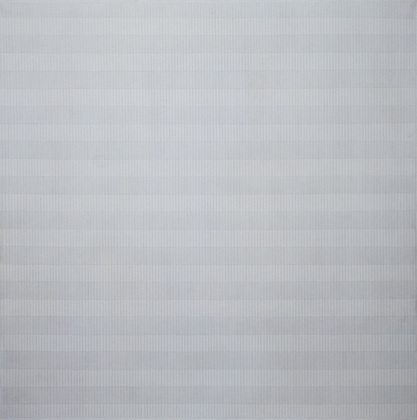
In 1959 Frank Stella carried a group of paintings called the *Black Paintings* into the annual exhibition at the Museum of Modern Art and watched curators argue about whether they were even finished. They were: thick parallel stripes of black enamel separated by thin bare canvas, following the shape of the support from edge to edge with no incident, no climax, no psychological drama. The Minimalist impulse in painting — separate from though related to the sculptural wing of Judd, Andre and Flavin — began in that refusal. Agnes Martin, working in near-isolation in New Mexico through the 1960s, arrived at a different but parallel answer: hand-ruled pencil grids on pale linen, almost invisible up close, and then suddenly radiant. Both painters were responding to what they saw as Abstract Expressionism's exhausted mythology of the self. Minimalism in painting did not abolish sensation; it relocated it, moving the viewer's experience from the drama of the brushstroke to the quiet facts of surface, scale and edge.
Origin and history
The Minimalist impulse in painting emerged from New York in the late 1950s and early 1960s, partly from within Abstract Expressionism and partly in reaction to it. Jasper Johns had already painted flags and targets — objects so literal that they resisted symbolic reading — and his formula, adopted by Stella, pointed the direction: reduce painting to what it physically is rather than what it represents or expresses.
Stella's *Black Paintings* (1958–60) were the most provocative opening move. Painted with a housepainter's brush, they used the stripes dictated by the width of the brush itself, following the contour of the shaped canvas edge inward. There was no composition in the conventional sense — the stripes were simply what happened when paint met shaped support. Stella's declaration at the time, later slightly misremembered into the phrase "what you see is what you see," was a wholesale rejection of the idea that painting needed to mean something beyond its own material reality.
Agnes Martin's path was quieter but equally radical. Working first in New York and then from 1967 in New Mexico, she distilled her canvases into near-monochrome fields of faint graphite lines on white or cream grounds. Her work was classified as Minimalist by critics and curators — she appeared in the landmark 1966 exhibition *Primary Structures* — though she always resisted the label, insisting her sources were internal rather than systemic. Bridget Riley in London and Frank Stella in New York show how painting Minimalism was never monolithic: Riley's Op Art optical vibrations share the economy of means but produce entirely different perceptual effects — shimmer and movement rather than stillness.
The intellectual grounding came from several directions: the Bauhaus principle that form should emerge from material and function; the Concrete Art of Max Bill and the Zurich school, which insisted on rigour and non-referentiality; and the critical writing of Clement Greenberg, whose idea of medium-specificity — that painting should be about what only painting could do — gave the movement its theoretical backbone, even as the painters themselves often outran his prescriptions.
Concept and philosophy
Minimalism in painting makes a philosophical claim: that the picture itself, as physical object, is a complete subject. This seems obvious once stated but was genuinely radical in 1960. The entire tradition of Western painting from the Renaissance onward had treated the canvas as a window — an opening onto a represented world. Minimalism closed the window.
The strategy required the elimination of what Stella called "relational painting" — the balancing of one element against another, the conventional compositional give-and-take that a viewer reads like syntax. Instead, the whole canvas is the element: Martin's grid covers the surface completely and uniformly; Stella's stripes run parallel from edge to edge without hierarchy. There is no focal point, no beginning and end. You receive the painting all at once, like a wall.
This does not mean Minimalist painting is emotionally inert. Agnes Martin wrote extensively about her work as an art of transcendence — the faint grid as a vehicle for states of joy and meditation. Her canvases repay long looking in ways that a photograph entirely fails to convey: the irregularities in the hand-ruled pencil lines, the way the raw linen breathes through the washes of pale paint, the almost imperceptible variations in pressure. The experience is closer to listening to a sustained musical note than to reading a painting.
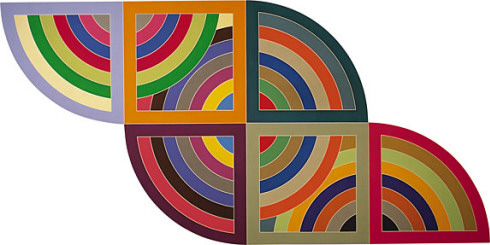
For Stella, the ambition was different: paint as object in the world, not as illusion of depth. His shaped canvases of the early 1960s — L-shapes, polygons, notched corners — make the point literally. The canvas is not a neutral ground on which composition happens; it is itself a shaped form that determines everything else. The stripes are not designed; they are the logical consequence of the shape. This commitment to internal logic rather than expressive choice is Minimalism's defining constraint — and its paradoxical freedom.
How to recognise it
Six visual markers that appear across Minimalist painting — recognise two or three together and you are almost certainly looking at work from the 1960s New York scene or its direct inheritors.
- Economy of means — One or two colours, one repeated element, no compositional drama. A Minimalist painting eliminates everything that is not structurally necessary — no gestural variation, no focal point, no narrative incident. If removing one more element would leave nothing, the painter has probably arrived.
- Impersonal, precise surface — No visible brushwork, no trace of the hand. Edges are hard and exact. Paint is applied evenly — often by roller, sometimes by fabricators rather than the artist. The *tenebristi* of gesture are gone; what remains is the fact of colour on a flat surface.
- Geometric and systematic form — Stripes, grids, concentric bands, right angles. The shape derives from a rule rather than a decision — Stella's stripes follow the canvas edge; Martin's grid is simply the repetition of a ruled interval. System replaces composition.
- Scale as content — Many Minimalist paintings are very large — not because the subject demands it but because scale is itself an element of the viewer's experience. A Martin grid at 180 × 180 cm becomes an environment; the same grid at postcard size would be a different work.
- Shaped or monochrome ground — Stella's early canvases have non-rectangular supports — polygons, L-shapes, notched edges — making the canvas itself a form rather than a neutral field. Martin's canvases are near-white; any trace of conventional figure-ground distinction is dissolved.
- Optical rather than gestural sensation — The experience unfolds slowly and physiologically. Martin's faint pencil lines produce a *humming* visual field that changes as you move. Stella's *Protractor* series (1967–69) generates optical interference from interlocking arcs of pure colour. The sensation is there — it just asks for attention rather than announcing itself.
Anecdotes and curiosities
**Frank Stella painted the *Black Paintings* in three months in 1958–59, working by night in his rented studio.** The canvases arrived at MoMA's *Sixteen Americans* exhibition in 1959, and the curators debated whether to include them at all — they read as unsettlingly close to nothing. Dorothy Miller included them. Philip Johnson bought two. The art world divided sharply: some saw them as a decisive new step, others as an elaborate joke at painting's expense. They are now regarded as founding documents of American Minimalism.
Agnes Martin left New York in 1967 and did not paint for seven years. She drove across the country in a truck she had built herself, eventually settling near Cuba, New Mexico, and constructing an adobe house without electricity. When she returned to painting in 1974, after her silence, her work had shifted from the tightly ruled early grids to broader, softer horizontal bands in pale, light-suffused palettes. She attributed the change to inner listening rather than formal research — a claim critics still debate.
**Bridget Riley's *Fall* (1963) caused museum visitors to report dizziness and nausea.** The painting — a field of curved black-and-white lines that produce an almost physical sensation of undulation — was shown at the ICA in London and became a public sensation. Riley received a letter from a gallery visitor complaining of a migraine. She was simultaneously annoyed and gratified: the painting was doing exactly what she intended.
**Stella's title *Die Fahne hoch!* (1959) is a line from the Nazi Horst-Wessel-Lied.** He later claimed the title was chosen purely for its formal shock value, not for ideological content — the painting is simply black stripes on black ground. The deliberate provocation of the title against the absolute blankness of the work was itself a Minimalist gesture: a maximum of cultural charge applied to a minimum of pictorial content.
Legacy and influence
Minimalist painting's influence on what came after it is partly visible and partly structural — it changed what painters felt they had to justify. After Stella and Martin, every mark on a canvas required a reason. The casual virtuosity of Abstract Expressionism, the knowing irony of Pop — both had to reckon with Minimalism's challenge: if painting can be this reduced and still demand serious attention, what exactly is a brushstroke earning?
Direct inheritors include Color Field painters who pushed monochrome to atmospheric extremes (Rothko had arrived there independently, but his late work became deeply entangled with Minimalism's afterlife), and the Systematic and Conceptual painters of the late 1960s and 1970s who followed the logic of the rule all the way to its dematerialisation. Sol LeWitt's wall drawings are essentially Minimalist paintings executed by others from written instructions.
In a broader sense, Minimalism gave contemporary painting — and design, architecture and graphic arts — a permission structure for restraint. The idea that less is not just less but can be more, that emptiness is a positive quality and not an absence, that the viewer's attention is worth cultivating rather than overwhelming — these are now design assumptions so widely distributed they have become invisible. Every white-walled gallery, every sparse product photograph, every website built on grid and negative space owes something to the decision Frank Stella made in a rented studio in 1958.
2 artists in this movement
Frequently asked questions
What is Minimalism in painting specifically?
In painting, Minimalism refers to work that reduces pictorial means to their irreducible elements: flat colour, geometric form, systematic repetition, no gestural expression, no represented subject. It differs from the Minimalist sculpture of Judd, Andre and Flavin in that it remains within the picture plane. Key painters include Frank Stella, Agnes Martin, and Ellsworth Kelly. The movement emerged in New York in the late 1950s partly as a reaction against the emotional excesses of Abstract Expressionism.
Is Agnes Martin a Minimalist painter?
She was consistently labelled Minimalist by critics and curators, and her work shares the movement's economy of means — near-monochrome palettes, hand-ruled grids, impersonal surfaces. However, Martin always resisted the label, describing her work as transcendental and rooted in inner emotional states rather than systematic formal logic. This tension — between the look of Minimalism and the feeling of Romanticism — is part of what makes her work so enduringly interesting.
How is Minimalism different from abstract art in general?
All Minimalist paintings are abstract, but not all abstract paintings are Minimalist. Abstract Expressionism retains gestural marks, personal emotion and compositional drama — everything Minimalism eliminated. Geometric abstraction (Kandinsky, Mondrian) often carries symbolic or spiritual content; Minimalism refuses that content. The distinguishing features are systemic logic (the form follows a rule), impersonal execution (no visible hand), and the insistence that the work is about nothing beyond its own physical reality.
What is a shaped canvas?
A shaped canvas is a support whose edges are not the conventional rectangle. Stella began making them in the early 1960s — L-shapes, polygons, notched and irregular forms — as a logical extension of his stripe formula: if the stripes follow the edge, the most honest thing is to make the edge part of the meaning. Shaped canvases collapse the distinction between painting and object, which is partly why they were so influential on the sculptural wing of Minimalism. Frank Stella's shaped canvases of 1960–65 are the canonical examples.
Why is Bridget Riley sometimes called a Minimalist?
Riley shares Minimalism's economy of means — simple geometric elements, systematic repetition, no gestural content — but her work produces a very different experience: optical vibration, apparent movement, perceptual instability. This is why she is more precisely described as an Op Art painter. The connection is real — both Op Art and Minimalism reduce painting to a small number of formal elements and let their logic run — but Op Art is interested in perceptual illusion rather than the physical fact of the painted object.