Las Meninas: who is Velázquez really painting?
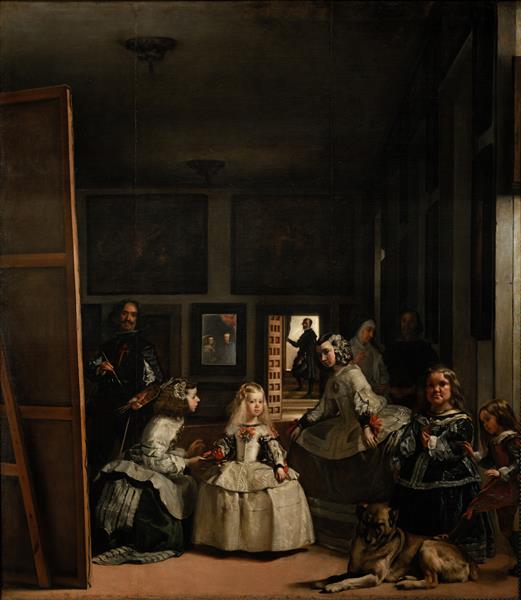
The most dazzling point-of-view trick in art. The huge canvas faces away from us — and a small mirror on the back wall reveals who's really being painted.
At first glance it's a royal-family snapshot: the little Infanta Margarita, her maids (las meninas), a dog, a dwarf, a nun murmuring in a doorway of light. Nothing unusual for a Spanish court painter. But Velázquez built a puzzle into this one — and the answer is on the back wall, easy to miss on a first pass.
Follow the mirror
That huge canvas on the left faces away from us; we never see what Velázquez is actually painting. But a small mirror on the back wall, lit just enough to catch the eye once you know to look, reflects two blurred figures: King Philip IV and Queen Mariana. They are standing exactly where we, the viewers, stand. The painting's real subject was never the little princess in the foreground — it's the royal couple, and, by a neat sleight of hand, you.
Look at the red cross on Velázquez's chest — the emblem of the Order of Santiago, one of Spain's highest honours. Tradition holds it was added after the painting was finished, since Velázquez wasn't inducted into the order until 1659, a year before his death and after Las Meninas was already on the palace wall. Some accounts even credit King Philip IV himself with adding the brushstroke.
The painter steps in
And who's that at the easel, brush in hand, looking straight out at us? Velázquez himself — full height, in the same frame as the future queen of Spain. Putting the painter into a royal portrait, as an equal presence rather than a hired hand kept discreetly out of frame, was a bold claim about the dignity of his art. A manifesto disguised as a family scene.
The painting doesn't just show a room. It shows you standing in it.
Could you name the painter cold?
Las Meninas is unmistakable once you know it. Sharpen your eye on 1,200+ paintings from 80+ masters.
Play the quiz →Why it still hooks us
Las Meninas keeps scholars arguing precisely because it refuses a single reading — who looks at whom, who is real, who is only reflected. The Italian painter Luca Giordano reportedly called it "the theology of painting", and centuries of critics have never quite settled what he meant. Stand in front of it and you complete the picture: you are, structurally, the king. That's the trick that never gets old.
More by Velázquez