Georgia O'Keeffe
She made you see the inside of a flower the size of a room — and once seen, you couldn't look at a flower the same way again.
Style and technique
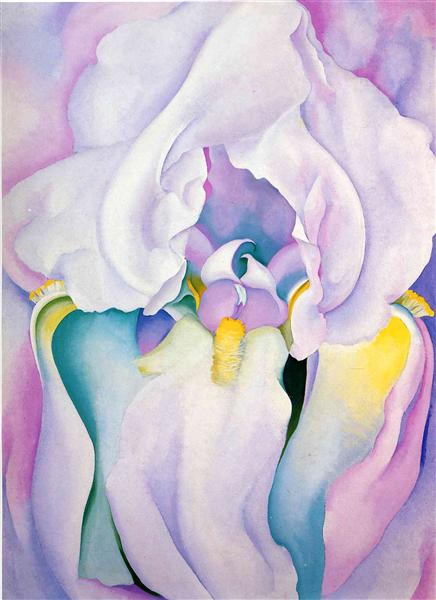
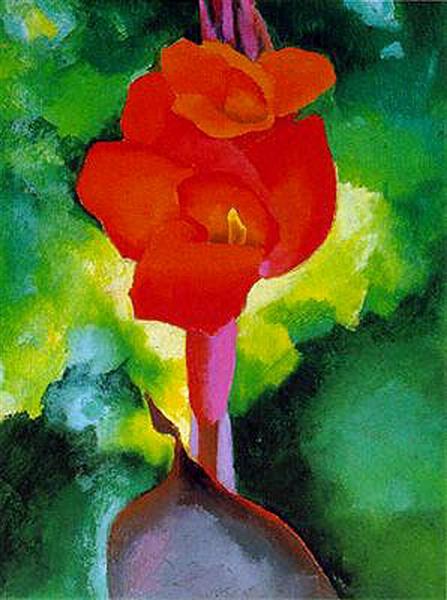
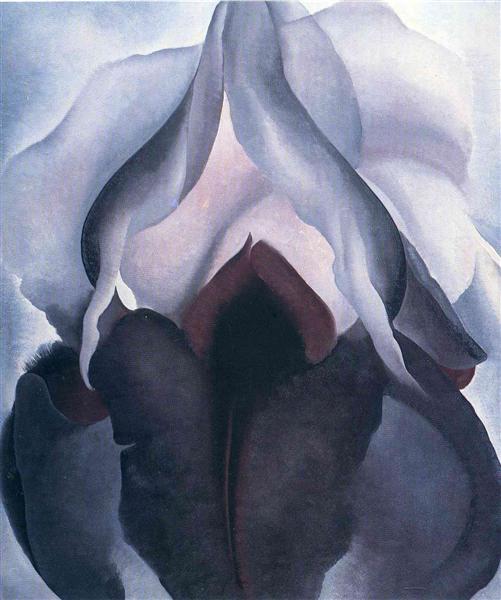
O'Keeffe's most famous paintings are the large flowers — canvases two or three feet high in which a single bloom fills the entire surface, the petals and sepals and stamen swelling to the edges and beyond, everything else excluded. The effect of this extreme close-up is to transform the familiar into the unfamiliar: you know the flower, but you have never seen it this way — this close, this large, this abstract at the edges, this specific at the centre.
Her method was not to distort or stylise but to select and magnify: she took a thing she had looked at closely and rendered it at a scale that made looking closely obligatory. The result sits in an interesting space between representation and abstraction — the images are clearly flowers, clearly skulls, clearly hills, but they are also close enough to pure form to function as abstract compositions.
The New Mexico works — made after she settled in Abiquiú in 1949 — are a different register entirely: arid landscapes of red and ochre hills, desert skies, the bleached skulls and pelvis bones she collected from the desert floor. These are more austere than the flower paintings, more concerned with the specific quality of light in a high-altitude desert, more interested in the geological rather than the biological.
Four fingerprints: extreme close-up that transforms familiar subjects by magnification, smooth, unbroken paint surface without visible brushwork — a taut, unmodulated finish that gives the forms a quality of presence without texture, the organic and the geological as primary subject matter, and an American West that is both literal landscape and emotional country — the New Mexico works are about a specific place and about a state of mind simultaneously.
Life and legacy
O'Keeffe was born on 15 November 1887 in Sun Prairie, Wisconsin, and knew by the age of twelve that she wanted to be an artist. She studied at the Art Institute of Chicago and then at the Art Students League in New York, where she received a conventional academic training in oil painting before rejecting it as insufficiently personal.
In 1912 she began teaching art in Amarillo, Texas, and encountered the landscape of the American Southwest for the first time. The sky, the flatness, the particular quality of the light in that part of the world — so different from Wisconsin and New York — struck her with the force of a revelation. Texas would feed her imagination for decades, even after she had moved elsewhere.
The decisive turn came in 1915–1916, when she destroyed her existing paintings and began working in charcoal on paper, making purely abstract forms without any reference to observed reality. She sent the drawings to her friend Anita Pollitzer in New York, who showed them to the photographer and dealer Alfred Stieglitz. Stieglitz showed them in his gallery without asking her permission, wrote to tell her, and began the correspondence that would eventually lead to their marriage.
Her New York years, from 1918 to the late 1920s, were the years of the flower paintings and the Manhattan buildings — the large-scale intimate close-ups that made her famous. She was also, as Stieglitz's partner and increasingly his muse, at the centre of the American Modernist art world. Stieglitz photographed her obsessively — hundreds of images — in a way that shaped and complicated her public identity.
In 1929 she made her first summer trip to New Mexico, and the landscape of Taos and the surrounding desert transformed her work as decisively as Texas had in 1912. She returned every summer for the next twenty years, until in 1949, three years after Stieglitz's death, she moved to Abiquiú permanently.
She died on 6 March 1986 in Santa Fe, aged ninety-eight, having worked almost to the end of a very long life.
Five famous paintings
White Iris with Black Iris 1926
A large canvas in which two irises — one white, one black-purple — fill the composition from edge to edge, their petals overlapping and curling. The white petals catch light in gradients of pure warm white; the dark iris behind them is almost completely tonal, its deep purple-black resolved into a series of swelling forms. The contrast between the two flowers — light and dark, open and closed, active and receding — gives the painting an almost musical structure of call and response. It is one of the most formally complete of the flower series and is in the New York Public Library collection.
Jimson Weed/White Flower No. 1 1932
The largest painting she ever made — nearly two metres on each side — showing a single jimson weed blossom at close range, its white trumpet-shaped petals filling the canvas. The flower is native to the American Southwest and is associated with desert heat, borderlands, and, in indigenous culture, visionary states. O'Keeffe had grown it in her garden in New Mexico. The scale is enormous; the petals and stamen are rendered in smooth, precise paint that gives them an almost sculptural quality. The painting sold for $44.4 million in 2014, the highest price ever paid for a painting by a female artist at that time. It is in the Crystal Bridges Museum of American Art.
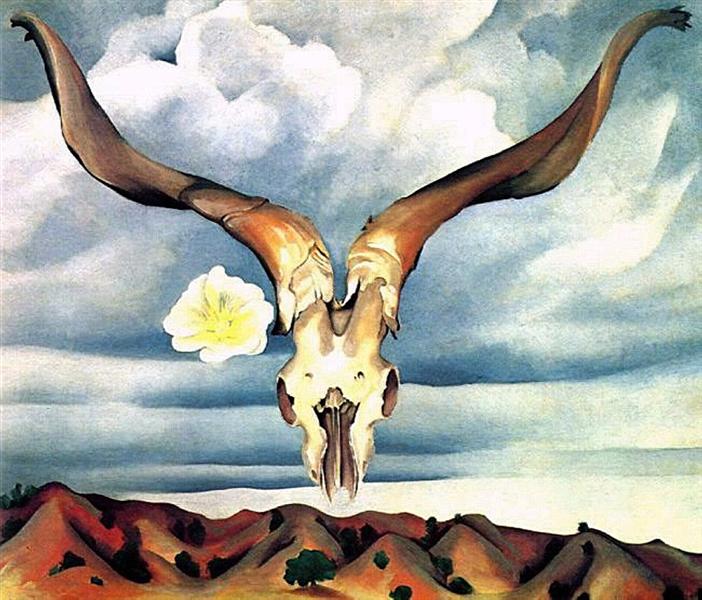
Ram's Head with White Hollyhock 1935
A ram's skull — bleached white, the horns intact — is positioned against the New Mexico sky above the distant Pedernal mesa, a white hollyhock flower placed at its side. The combination of the organic and the geological, the living flower and the dead bone, the sky and the earth, is characteristic of her New Mexico period. The skull is not macabre in her use of it; it is beautiful — a found form as perfect as any she could have designed. The bone and flower relationship appears throughout her work of this period, and this is one of the most elegantly balanced examples.
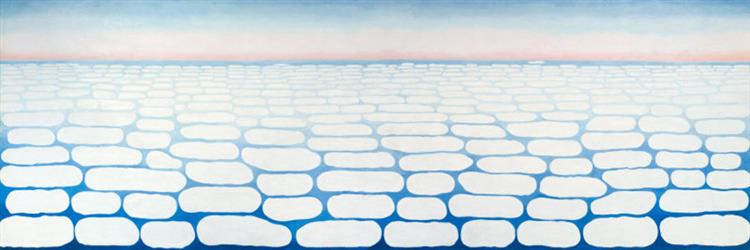
Sky Above Clouds IV 1965
The largest canvas she ever painted — almost eight metres wide — showing a view from an aeroplane window of clouds stretching to the horizon, the small white ovals of cloud-tops receding in perspective into a blue sky that becomes darker toward the upper edge of the canvas. The image is simultaneously deeply real — she made these paintings after observing this exact view from transatlantic flights — and almost cosmically abstract. The scale of the painting and the scale of the subject are perfectly matched. It is in the Art Institute of Chicago.
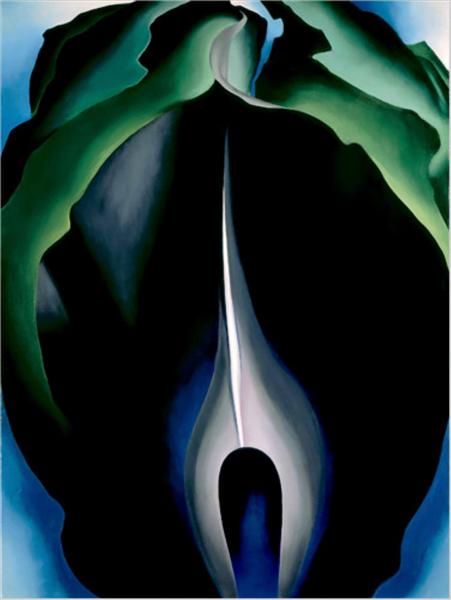
Black Iris 1926
A single black-purple iris, its petals filling the canvas, the innermost parts of the flower dissolving into deep shadow. The painting was made the same year as several other iris works, but this is the most dramatic: the near-absence of light in the central passages, the heavy curves of the outer petals, the way the flower seems to enclose itself in darkness. Stieglitz showed it in 1927 and critics interpreted it in sexual terms — an interpretation O'Keeffe denied throughout her life, insisting the painting was about a flower. It is in the Metropolitan Museum of Art in New York.